
Chassis and Wheel Alignment Machine
Welcome to the future of heavy-duty vehicle servicing. Commercial vehicles endure overloaded axles, low-speed curb strikes, and years of flexing across rough yards and unpaved access roads.
- Products
- Heavy Duty Repair System
- Chassis and Wheel Alignment Machine
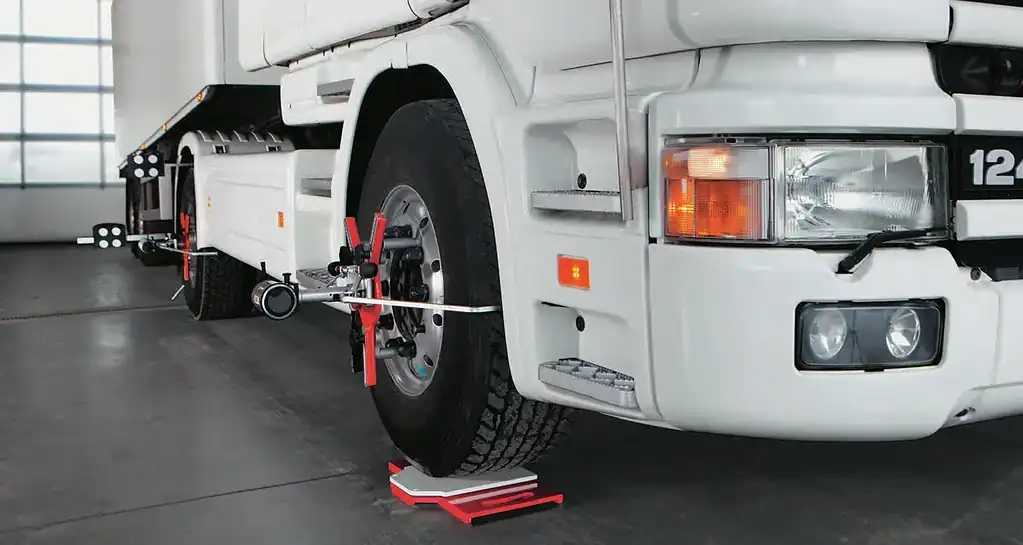
Precision Alignment & Frame Diagnostics for Trucks and Commercial Vehicles
Our advanced solutions, CELETTE AXIS4000 and CELETTE CMC4000, are designed to enhance your workshop’s capabilities with unmatched accuracy, speed, and OEM-grade reliability.
What Is Truck Chassis Alignment?
Truck chassis alignment is the process of measuring a vehicle’s frame and axle geometry against manufacturer specifications, then correcting what’s outside tolerance. The frame serves as the reference for the axles, suspension mounts, the fifth wheel, and the body subframe: everything takes its position from it. So, a proper chassis alignment check starts at the frame and works outward. Set the centerline first, then measure the axles against it.
Chassis Alignment vs. Wheel Alignment
Wheel alignment adjusts the angles at which the wheels meet the road: toe, camber, caster, and thrust angle. Chassis alignment tests that assumption. It measures the frame for lateral warpage, height variation between the left and right rails, and torsion along the length of the vehicle.
Here’s why the difference matters commercially. A shop that only offers wheel alignment can set a steer axle to spec and still hand back a truck that dog-tracks down the highway because the rear axles locate off a twisted frame. The customer comes back. The comeback costs you labor, and it costs you the relationship. Run a chassis alignment check first, and you know, before you touch a tie rod, whether the wheel alignment will hold.
When Does a Truck Need a Chassis Alignment Check?
- After a crash, even a slow one. It does not take a big impact to bend a frame.
- When tires wear unevenly or wear out too fast, especially on the drive axles.
- When the truck crabs or travels slightly sideways, or the steering wheel sits crooked on a straight, flat road.
- When wheel alignment settings drift back within a few weeks, the frame is usually the reason.
- After the chassis has been changed: wheelbase altered, extra axle fitted, new body, crane or tail lift installed.
- After a rollover, a jackknife, or a load shifting hard in transit.
Choose the Right Chassis Alignment Tool for Your Workshop
The right chassis alignment tool depends on the work you actually do. Here’s what each system handles.
Celette AXIS4000 – Mobile Wheel Alignment for Trucks & Trailers
The Celette AXIS4000 is a revolutionary mobile wheel alignment system tailored for commercial vehicles, trailers, and agricultural units. With its 360° rotatable camera heads and wireless data transmission, AXIS4000 delivers precise axle measurements, without lifting or disassembly. Whether you’re servicing a fleet or running a high-volume workshop, this system ensures fast, reliable alignment in real-world driving conditions.
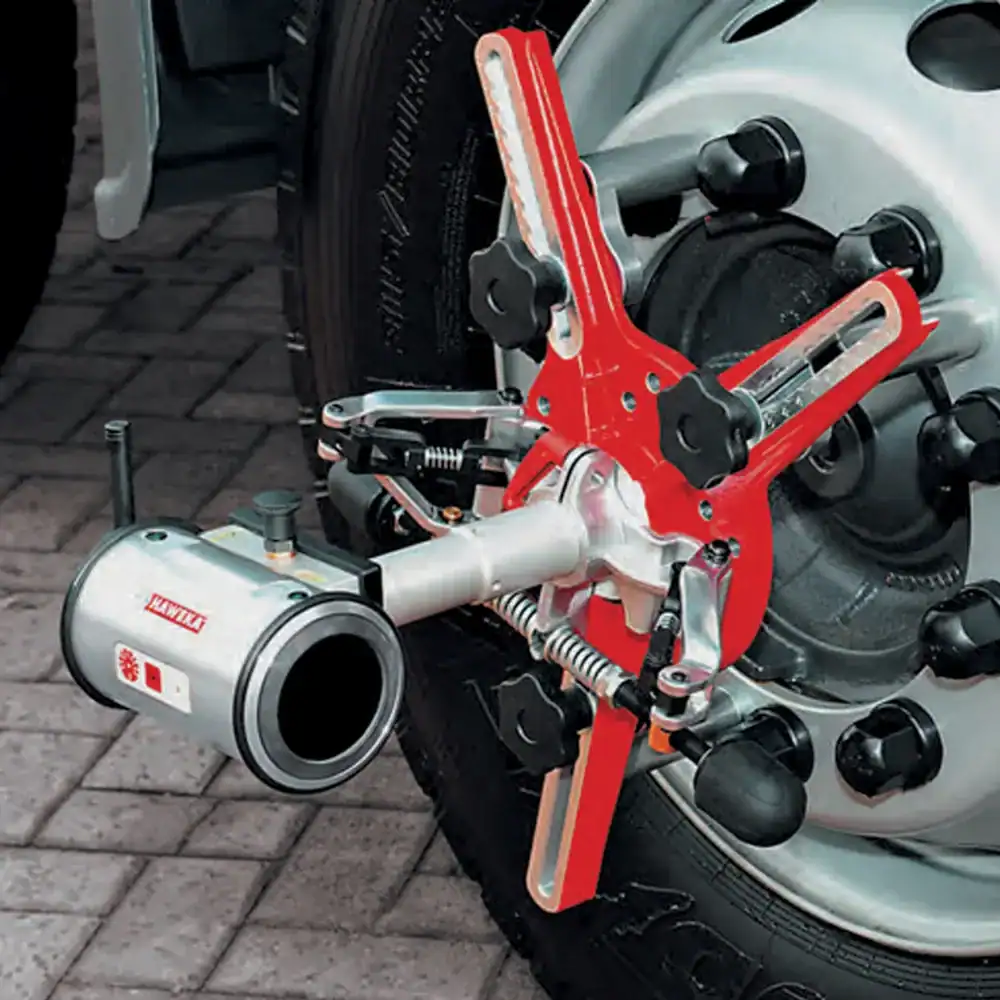

Celette CMC4000 – Frame Measuring System for Heavy-Duty Repairs
The CELETTE CMC4000 is a high-precision, camera-based measuring system designed for diagnosing and restoring truck and bus frames. Capable of analyzing offset, torsion, and structural deformation with millimeter-level accuracy, the CMC4000 supports frames up to 18 meters long. Its intuitive software and customizable measuring matrix make it an essential tool for OEM-certified collision repair centers.
Truck Chassis Alignment Check: What Technicians Measure
Axle Alignment and Thrust Direction
Every axle should sit square to the frame and parallel to the other axles. When one does not, the vehicle travels at a slight angle to the direction in which the steering wheel is pointing. The condition is commonly described as crabbing or dog-tracking, and it wears tires rapidly.
A truck chassis alignment records:
- Toe on each wheel and each axle, meaning whether the wheels point slightly inward or outward
- Camber and caster on the steering axle, meaning how the wheels lean and how readily the steering returns to center
- Kingpin inclination, the angle of the pivot around which the wheel steers
- Axle offset, and whether the axles sit parallel to one another
- Thrust angle, the direction in which the rear axles are actually driving the vehicle
- Whether the steering box is centered, and the maximum steering angle
Frame Offset, Twist and Torsion
Frame damage takes three forms:
- A sideways bend means the two rails have shifted laterally relative to each other, so the frame no longer forms a straight line when viewed from above.
- A height difference means one rail sits higher than the other along part of its length, which affects suspension geometry and the way the load is carried.
- A twist means the front and rear sections of the frame have rotated relative to one another.
A rail can sit far enough out of position to destroy a set of tires while still appearing entirely normal. This is the reason to fit a chassis alignment machine to the vehicle rather than rely on visual assessment.
Before-and-After Measurement Reports
Both CELETTE systems generate a report showing the values recorded before work began and the corrected values on completion. That record demonstrates to the customer that a fault existed and has been corrected, supports the invoice if an insurer questions the scope of the repair, and provides fleet managers with data to track over the vehicle’s service life. The data also satisfies manufacturer requirements for signing off on structural repairs.
Workshops that maintain accurate measurement records also quote more precisely over time. Once the frequency of frame damage inside apparently minor panel work becomes visible, pricing adjusts accordingly.
AXIS4000 vs. CMC4000: Which System Do You Need?
For fleet servicing, tire problems, and steering complaints, the AXIS4000 is the starting point. For collision-damaged trucks and buses, the CMC4000 is more suitable. Workshops handling substantial structural repair generally operate both, since aligning the wheels on a bent frame produces a temporary result and a return visit.
From Chassis Diagnosis to Frame Straightening
Once the CMC4000 has established that the frame is outside tolerance, the repair is performed on a straightening system. The vehicle is anchored, hydraulic force is applied in a controlled manner, and the frame is then measured again to confirm that it has moved into position and remained there.
CELETTE’s heavy-duty range covers this stage of the work. The Mamouth mobile rig provides towers with full 360-degree movement around the vehicle and 23 tons of hydraulic pulling power. BPL rail systems are installed into or on top of the floor, providing anchor points along the length of larger vehicles. These systems allow a workshop to take a heavy vehicle from the initial chassis alignment check through straightening to final verification on its own premises.
Frame Machine Solutions for Auto Body Shops
CELETTE frame machines for body shops, including the Sevenne, Rhone, and Griffon benches, provide a stable platform for anchoring a vehicle. MZ jigs are manufactured for specific models, while the Cameleon universal jig system covers vehicles without a dedicated jig set. Measuring systems such as NAJA 3D verify the vehicle before repair begins and again once it is complete, comparing each point against the manufacturer’s own reference data.
Request a Truck Chassis Alignment System Demo
CELETTE equipment is in service in more than 100 countries, supported by manufacturer approvals and a technical department to provide training, configuration advice, and troubleshooting. CELETTE provides demonstrations and technical training on chassis alignment machines, enabling your team to operate the equipment, take live measurements, and assess how the reporting aligns with existing workshop procedures.
A demonstration typically covers the setup time on vehicles, measurement accuracy, the software and the reports it produces, and the training your technicians will require. It will also determine which configuration suits your bay layout and throughput.
Upgrade your workshop with tools trusted by professionals worldwide.
Contact CELETTE to arrange a demonstration, request a quotation, or discuss which chassis alignment tool suits your workshop.
Frequently Asked Questions About Truck Chassis Alignment
Q: What is the difference between truck chassis alignment and wheel alignment?
A: Wheel alignment sets the angle of the wheels and assumes the frame beneath them is straight. Chassis alignment checks the frame itself for a sideways bend, a height difference between the two sides, or a twist. If the frame is out of position, a wheel alignment will not hold.
Q: How often should a truck receive a chassis alignment check?
A: There is no fixed interval, as it depends on how the vehicle is used and the conditions it operates in. A check is warranted after any collision, after a chassis modification, before purchasing a used vehicle, and whenever tires wear unevenly or an alignment fails to hold. Many fleets now include a check as part of scheduled servicing.
Q: Can a chassis alignment machine measure a truck without removing components?
A: Yes. The CELETTE CMC4000 measuring bars hook onto the frame from the inside, so the fuel tank, spare wheel and toolbox can remain in place.
Q: Does the CELETTE AXIS4000 require a lift or a level floor?
A: No. It measures the vehicle in normal driving condition on its own wheels, with no lift, pit or perfectly level floor required. This is what makes it suitable for mobile service calls and on-site work.
Q: Which chassis alignment tool should a body shop acquire first?
A: Where most work involves collision damage, the CMC4000 answers the first question: is the frame straight? Where the work leans toward fleet servicing, tire wear and steering complaints, the AXIS4000 will be used more often. Workshops handling both usually acquire the pair.
Connect with CELETTE Worldwide
CHINA
-
CELETTE AUTO EQUIPMENT AND REPARATION
Room 3, 11F, Xing Hui Building, No 176, Min Yang Road, Jiaxing, 31400 Zhejiang Province / CHINA - +86 158 8831 7667
- [email protected]
FRANCE
-
CELETTE SAS
80, Impasse des Bretteaux 42410 SAINT MICHEL SUR RHÔNE FRANCE - +33 474 575 959
- [email protected]
GERMANY
-
CELETTE DEUTSCHLAND GMBH
Eugen-Ensslin-Str.3 77694 KEHL GERMANY - +49 785 195 58 712
- [email protected]
INDIA
-
CELETTE INDIA PVT LTD.
2/122 B-1, Mylampatty Road, Karayampalayam, Coimbatore 641062 / INDIA - +91 88 70 86 11 11
- [email protected]
JAPAN
-
CELETTE JAPAN TECHNICAL OFFICE
667-9 Mabashi, Shisui-Machi, Inba-Gun,Chiba 285-0914 / JAPAN - +81 70 2183 1960
- [email protected]
THAILAND
-
CELETTE ASIA PACIFIC
700/941 M.5 Amata City Chonburi Industrial Estate, Nongkakha, Phanthong 20160 Chonburi THAILAND - +66 905 630 258
- [email protected]
USA
-
CELETTE INC. TEXAS
122 Valley Ridge Blvd. Unit G Lewisville, TX 75057 / USA - 1-800-CELETTE
- [email protected]
Get in touch with us directly
Have a question or want to learn more? Drop us a message
below. We’d love to hear from you!
Have a question or want to learn more? Drop us a message below — we’d love to hear from you!
