
Floor Frame Machine and Straightening Systems
Whether you need a traditional steel-rail floor frame machine or a flush in-floor straightening system, CELETTE helps body shops match structural repair equipment to vehicle mix, available floor space, and repair workflow.
- Products
- Alignment and Straightening Systems
- Floor Straightening Systems
What Is a Floor Frame Machine?
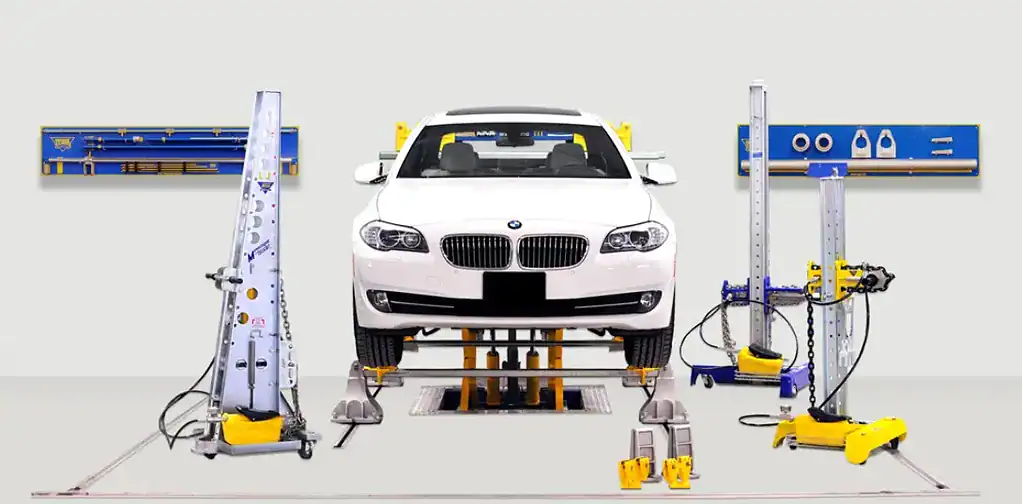
A floor frame machine is a straightening setup built around rails fixed into or onto the workshop floor rather than around a raised bench. The rails serve as anchoring points and as force-transfer points, so the concrete slab carries the reaction load while hydraulic equipment applies force to the damaged structure.
The vehicle is clamped at its sills or pinch welds, the pulling tower is positioned along a rail wherever the geometry calls for it, and the correction proceeds from there. Nothing has to be lifted onto a platform first, which is often the deciding factor with a vehicle that no longer rolls or steers.

Celette
System 5000
A world-renowned conventional steel-rail floor system, the CELETTE System 5000 stands as the gold standard in traditional vehicle chassis straightening platforms. Built on robust steel rails securely fixed to the workshop floor, System 5000 provides unwavering stability and versatility for collision repair. This reliable in-floor straightening system allows precise alignment and powerful pulling for a wide variety of vehicle makes and models.
Fixed Steel Rails for Reliable Anchoring
Steel rails set into concrete give a floor system its stability. Structural pulls generate a significant reaction force, and anything that flexes under that load introduces error into the repair because the frame of reference shifts with the vehicle. With fixed rails, the anchoring points stay exactly where they were installed, year after year, and a technician clamping a vehicle knows the platform will not move, regardless of how much force is applied to the pull.
Universal Compatibility and Modular Design
With its universal compatibility and modular design, the System 5000 brings decades of CELETTE’s expertise into every repair, ensuring repeatable accuracy, technician safety, and OEM-approved results.
Two Pulling Operation Units
for Every Repair Need
3-Point Composition
The 3-point composition, or System 3P, is the configuration most commonly specified with the System 5000. Engineered for versatility, this unit offers multi-directional pulling from three anchor points, enabling accurate correction of structural distortions on even the most complex bodyframes.


Dyno2000
A high-performance pulling solution designed for heavy-duty operations, Dyno 2000 delivers exceptional controlled force and flexibility. It is an ideal choice for demanding collision repair tasks on both passenger and commercial vehicles.
CELETTE Wedgeclamp System
An ultra-low-profile modern rail solution, CELETTE Wedgeclamp System offers a modern approach to chassis holding and pulling, utilizing innovative aluminum rails that sit virtually flush with the workshop floor. It uses compact aluminum rails, wedges and clamps to anchor, pull and measure a vehicle within a single work bay, with rails that sit close to flush with the floor. Its ultra-low profile provides exceptional accessibility and a sleek, clutter-free work area, ideal for shops aiming to maximize their operational space.
Chainless Anchoring System
The chainless anchoring configuration sets up in minutes and suits most medium-sized vehicles. Four lightweight anchor stands bolt to compact rails, mounted either on the floor surface or embedded into the concrete, and lock the vehicle firmly in place for pulling or straightening.
Floor Straightening System vs. Car Bench Frame Machine
A car bench frame machine holds the vehicle on a raised platform, usually in combination with dedicated or universal jigs that position the structure at manufacturer reference points. A floor system anchors the vehicle at floor level and applies force through rails set into the slab. It offers speed, accessibility, and adaptability, which is why it remains one of the most widely used methods in collision repair.
When a Floor System Is the Better Fit
A floor setup is suitable for vehicles that cannot be driven or rolled onto a platform, and for vehicles with panel and light structural work or multi-damage repairs that require simultaneous force from several directions. It is also designed for shops with limited floor area and mixed workloads, where a bay handles structural work one day and general repairs the next, since the rails do not occupy the bay when idle.
When to Choose an Auto Body Frame Machine
A bench becomes the right answer when the repair must be verified against manufacturer data, such as for certified structural repairs, where a manufacturer program requires jig-based positioning and documented results. An auto body frame machine is also more suitable for repairing vehicles with bonded or riveted structures, where the shell has to be held precisely while the adhesive cures, and electric vehicles, where battery enclosure geometry has little tolerance for approximation.
Get a Floor Straightening System Configured for Your Shop
CELETTE’s technical department reviews bay dimensions, vehicle mix, and existing equipment before recommending a configuration, so the installed system matches how the shop actually operates.
A consultation typically includes rail layout and anchoring positions for your bay, whether surface-mounted or embedded installation suits your premises, which pulling unit fits your vehicle mix, how the system works with anchoring fixtures and measuring equipment already in service, and the training your technicians will need.
Contact us to discuss a floor frame machine configuration, request a demonstration, or ask for CELETTE’s equipment catalog.
Frequently Asked Questions About In-Floor Straightening Systems
Q: What is a floor frame machine?
A: It is a straightening setup built around rails fixed into or onto the workshop floor instead of a raised bench. The rails act as anchoring and force-transfer points, so the vehicle is clamped at floor level and hydraulic equipment applies pulling, pushing or vector force to correct the damage.
Q: How does a CELETTE in-floor straightening system compare with a bench?
A: A floor system offers speed, accessibility and adaptability, and it handles vehicles that cannot be driven onto a platform. A jig-based bench provides millimetric reference accuracy against manufacturer data, which a floor system does not. Shops handling certified structural repair generally operate both.
Q: Do the rails have to be embedded in the concrete?
A: Not necessarily. CELETTE WedgeClamp rails can be mounted on top of the floor or embedded flush into the concrete. Embedding gives the cleanest bay and a flush finish, while surface mounting installs faster and suits leased premises.
Q: What is the difference between CELETTE’s 3-point composition and the Dyno 2000?
A: The 3-point composition provides multi-directional pulling from three anchor points, which suits structural distortion running in more than one plane. The Dyno 2000 is a higher-force pulling tower for demanding work, including light commercial vehicles. Both use the same System 5000 rail base.
Q: Can a car bench frame machine and a floor system be used together?
A: Yes, and many workshops do. The floor system absorbs volume work, panel pulls and vehicles that arrive undriveable, while the bench handles certified structural repair with jig positioning and measurement. Anchoring fixtures and measuring equipment carry across both.
