
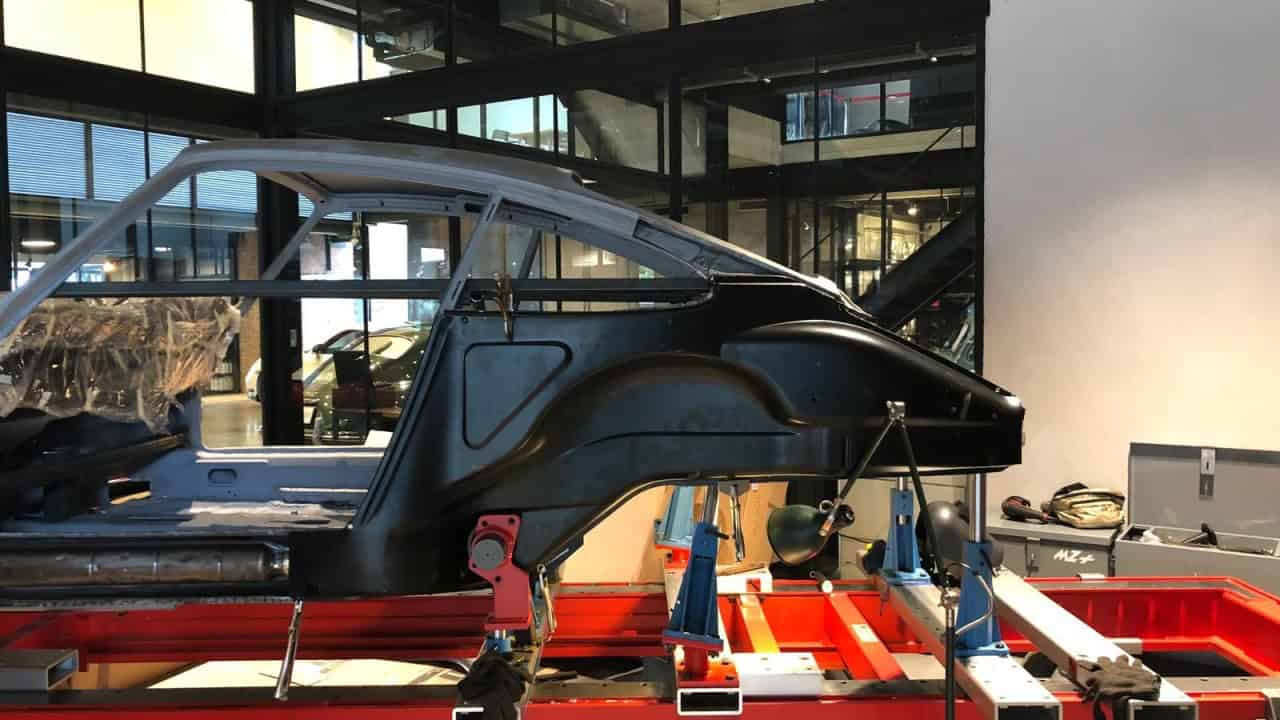
Intro — A Legacy of Precision, A Vision for Tomorrow
Since its foundation in 1953, Celette has held one uncompromising belief: a repaired vehicle must be restored to its original manufacturer dimensions, not approximately, but exactly. This conviction was not driven by regulation. It was driven by the conviction that road safety begins on the repair bench.
The collision repair industry is now entering a new era. Advanced Driver Assistance Systems (ADAS), automatic emergency braking (AEB), lane-keeping assist, adaptive cruise control, and intelligent speed assistance are no longer premium options. Under EU Regulation GSR2, all newly registered vehicles in Europe must be equipped with these systems as of July 2024. A further phase of mandatory features is scheduled for July 2026. ADAS is not the future. It is the present, and collision repair must rise to meet it.
Understanding Celette’s Role in ADAS Calibration
Beyond Europe: The U.S. is converging on the same ADAS trajectory
The regulatory push toward ADAS is not limited to Europe. In the United States, the National Highway Traffic Safety Administration (NHTSA) finalized in 2024 a new Federal Motor Vehicle Safety Standard — FMVSS No. 127 — that will make automatic emergency braking (including pedestrian AEB) mandatory on all passenger cars and light trucks by September 2029.
In parallel, NHTSA is overhauling the New Car Assessment Program (NCAP) to incorporate a richer set of ADAS functions into its 5‑star ratings, supported by a 10‑year roadmap of test procedure updates.
Taken together, EU GSR2 in Europe and FMVSS No. 127 plus the NCAP roadmap in the U.S. send the same clear message: ADAS is becoming a regulated baseline, and accurate structural and geometric repair is now a pre‑condition for compliance, not just a best practice.
1. Safety by Design: Before ADAS Even Existed
When the Celette bench concept was developed, ADAS did not exist. Yet the founding engineering philosophy was already aligned with what ADAS demands today: restore the vehicle to factory geometry with the highest possible precision.
Every Celette bench was conceived as a metrological reference surface, a structural datum against which a damaged vehicle could be measured, aligned, and restored.
Dedicated jigs (vehicle-specific fixtures), cross-members, and MZ Towers were designed to position each structural reference point to OEM-specified coordinates.
The ACM dimensional database, now exceeding 25,000 vehicle models, was built to ensure that every jig position corresponds perfectly to the original 3D geometry of the factory floor.
This was, in essence, ADAS preparation before ADAS existed. Because a vehicle whose structural geometry is accurately restored can be correctly recalibrated. A vehicle with residual geometric deviations cannot.

2. The ADAS Imperative: Why Geometry Precision Now Matters More Than Ever
ADAS systems depend on sensors, cameras, radar, and LiDAR that are mounted at precisely defined positions on the vehicle body. These sensors must maintain millimeter-level alignment to function correctly.
The Cost of Imprecision:
- Research confirms that a misalignment of as little as one degree can cause complete failure of emergency braking systems.
- Modern ADAS sensor mounting points require ±1 mm precision.
- An estimated 75% of required ADAS calibrations are currently missed in the collision repair industry.
A 2021 Canadian study found that estimators missed 90% of needed calibrations across 100 collision repair estimates.
The trend is irreversible: 89% of model-year 2023+ vehicles now require ADAS calibration following a windshield replacement alone. Structural repairs, which directly affect sensor mount geometry, trigger calibration requirements across virtually all ADAS systems.
The implication for the equipment industry is direct: the bench is no longer just a structural tool; it is the foundation on which ADAS recalibration is validated.

3. Benchmark 2019: Our Own Data, Transparently Shared
In December 2019, Celette conducted a rigorous, internal benchmarking study of its jig systems using a Leica Absolute Tracker under controlled laboratory conditions at Celette’s measurement facility in Vienne, France.
A total of 240 measurement points were recorded across three configurations:
- Dedicated jigs in a Regular MZ Tower
- Dedicated jigs in a Low Tolerance MZ Tower
- Universal jigs (Cameleon) in a Regular MZ Tower
2019 Benchmark Results Summary:

Celette jig systems achieve positional accuracy and slack/play levels that remain well within OEM manufacturer tolerances for structural repair before ADAS recalibration. The Low Tolerance MZ Tower configuration demonstrated a meaningful improvement in slack control (0.7 mm) compared to the standard configuration (0.8 mm). Dedicated jigs consistently outperform universal jigs on both metrics, confirming the value of vehicle-specific tooling for premium repair.
This is not a marketing claim; it is documented measurement data.
4. Celette Bench Accuracy — Verified with KEYENCE WM‑6010
Celette conducted a full metrological validation of its Rhone XL bench using the KEYENCE WM‑6010 Wide‑Area Coordinate Measuring Machine, an optical tracker with a 10‑meter measuring range and a repetitive accuracy of ±28 µm. This allows the bench to be inspected with the same rigor that OEMs apply to critical production fixtures.
Full-Frame Flatness: (KEYENCE WM‑6010)

After applying a 0.037 mm simulation correction factor, the XL bench achieved a verified full‑frame flatness of 0.246 mm, comfortably within Celette’s internal specification of 0.250 mm maximum.
In a separate internal benchmark comparing the XL bench to several widely used competitor systems, the full‑frame flatness deviation of those systems was several times higher than the 0.246 mm achieved by Celette.
5. Where We Stand — And Where We Are Going
Celette is transparent: even when current equipment enables repairs within OEM tolerances, the evolving ADAS regulatory landscape demands a new level of engineering ambition.
Celette’s internal data reveals specific improvement opportunities, such as cumulative X-axis hole deviations reaching up to +0.790 mm at the bench’s furthest points, or Z-axis stacking deviations appearing when fully loaded.
These findings are not failures; they are a roadmap. And Celette is committed to acting on them.

6. The Celette Next-Generation Engineering Program
Celette is formally launching a multi-axis engineering improvement program structured around five strategic pillars:
a) Bench Flatness (Targeting Sub-0.3 mm Performance): Level flooring precision in ADAS calibration bays must respect tolerance within fractions of a degree; the bench itself must be held to the same standard.
b) Tower and Piston Machining (Eliminating Mechanical Slack): Celette will invest in tighter machining tolerances across MZ Tower bodies, piston shafts, and locking mechanisms to systematically eliminate assembly play.
c) Cameleon and Jig Tolerances: Celette will redesign the Cameleon interface geometry and clamping mechanisms to bring universal jig performance closer to dedicated jig levels.
d) Advanced Materials: Celette will evaluate the application of advanced aluminum alloys and carbon fiber composite structures to reduce thermal drift, improve rigidity, and reduce weight.
e) OEM 3D CAD Database Expansion: Celette is actively pursuing bilateral agreements with OEM manufacturers to obtain native 3D CAD files for all current and future models, enabling digital-to-physical comparison at sub-millimeter accuracy through the Celette WebTools AI.
7. The Celette Certification Program: Tooling You Can Trust
Precision equipment alone is not sufficient. Under the Celette Certification Program, bodyshops undergo structured qualification on bench setup, jig selection, and assembly verification procedures.
Only shops that demonstrate proficiency are certified, providing insurers and OEM networks with a documented guarantee. Mercedes-Benz, for example, requires Celette-approved benches and jig sets as part of its Certified Collision Program.
8. The Road Ahead: Safety as a Shared Responsibility
When a vehicle’s geometry is incorrectly restored, no ADAS calibration—however sophisticated—can compensate for displaced sensor mount points. The repair bench is the first link in the safety chain.
The next generation of Celette equipment will carry this commitment further: tighter tolerances, better materials, richer data, and a certification framework that gives the entire automotive repair ecosystem the confidence that a vehicle repaired on a Celette bench is restored to the precision modern safety systems demand.
Precision is not a feature. It is a responsibility.
Celette Group – | Since 1953 | celette.com
Over 25,000 vehicle models database.
Trusted by leading OEM certification programs worldwide.
Disclaimer — Methodology and scope of results :
The measurements and analyses presented in this document are based on internal studies carried out by Celette on a limited number of benches, tooling configurations and setups, under controlled conditions and using specific metrology equipment, including a Leica Absolute Tracker and a KEYENCE WM‑6010 CMM system. These studies are intended to illustrate the level of precision achieved by Celette solutions and do not constitute a statistically representative market study or an exhaustive ranking of available equipment. The results are provided for information purposes only and do not guarantee that identical performance will be obtained in other workshops, environments or usage conditions. It remains the responsibility of each OEM, network, insurer and bodyshop to conduct its own testing, validation and due‑diligence processes before making any technical, operational or investment decision.




