

As modern vehicles incorporate more sensors, software, and mixed-material construction than their predecessors, traditional repairs are understandably lagging.
This guide covers where AI in auto repair fits today, how to use it at each stage of a repair job, and what to look for when integrating AI repair tools with existing processes.
Why AI Is Changing Automotive Repair
IIHS research found that even small misalignments after a repair can disrupt advanced driver assistance system (ADAS) cameras and sensors, leaving critical safety features compromised once the car leaves the shop. About fifty percent of vehicle owners polled experienced problems with their ADAS after repairs to those systems. Therefore, reactive troubleshooting lacks the precision needed for these sophisticated repairs.
Advanced AI fills this gap because it gives shops direct access to specific structural data, OEM jig configurations, and live measurement feeds in a single guided workflow. Purpose-built platforms pull 3D references on demand, letting technicians synchronize measurements for better consistency.
How AI Is Used in Automotive Repair Today
Identifying Fault Sources
Modern AI diagnostics use machine learning to map relationships between ECUs and subsystems. When a vehicle throws several seemingly unrelated DTCs, the algorithm can trace them back to a single failing power supply or shared circuit, saving hours of testing.
The latest tools are more engaging, with some platforms enabling instant issue assessment and direct communication with technicians, thus functioning more like an assistant than a mere diagnostic device. AI is enhancing precision and reducing repair expenses for engines, transmissions, brakes, suspensions, and electric vehicle components.
Predictive Maintenance
Catching issues early avoids expensive component replacements down the line. Newer predictive systems also factor in driving behavior, regional climate data, and usage patterns to refine their forecasts.
Structural Measurement and Collision Repair
Modern bodies use mixed materials, high-strength steels, and aluminum sub-structures that demand sub-millimeter alignment accuracy.
Restoring crashworthiness on a current-model vehicle takes millimetric precision and verified OEM data. A complete AI collision repair software assists technicians in confirming all measurements and generating documentation that meets strict OEM and insurer standards.
Shop Workflow Automation
AI also frees technicians from repetitive, menial tasks. Appointment scheduling, customer updates, quote generation, and follow-ups can all be automated, freeing up hands for actual repair work.
Diagnostic assistants powered by natural language processing pull from technical manuals, past repair records, and live telemetry to suggest next steps, helping less experienced technicians follow approved workflows with fewer errors.
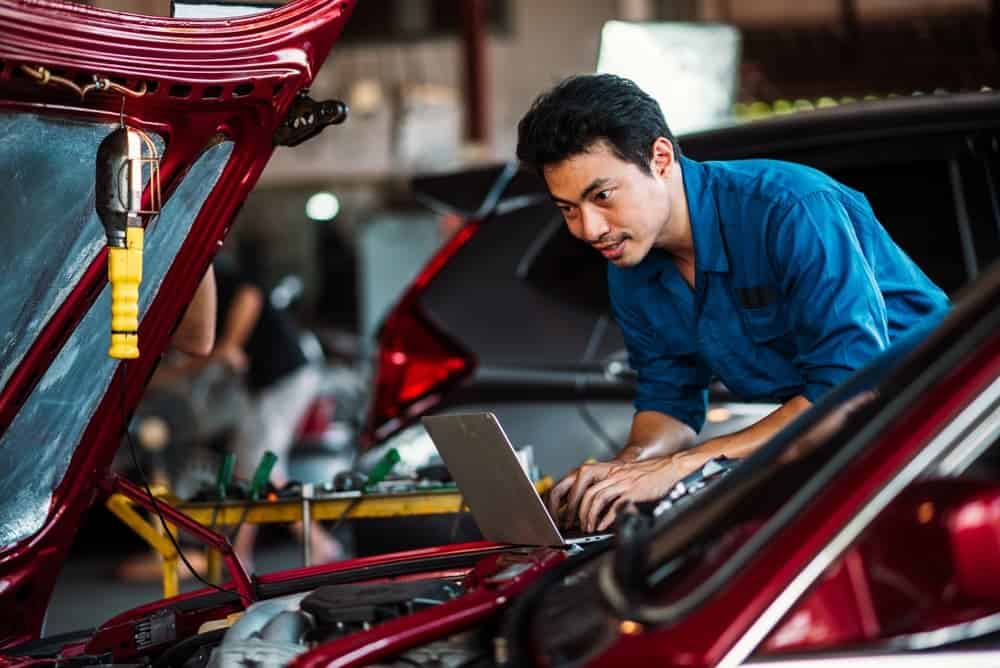
How to Use AI at Each Stage of the Repair Process
Step 1: Pre-Repair Assessment
Use AI to identify the vehicle, pull its history, and generate a condition report before touching the car. With AI collision repair software like Celette AI WebTools, the technician selects make, model, and year. The platform provides structural data, OEM-approved reference points, and 3D views, with color-coded indicators flagging any deviation from spec.
Step 2: Diagnostics and Root Cause Analysis
Feed live sensor data, DTCs, and vehicle history into AI diagnostic tools to narrow down the source of the fault. As a result, two technicians using the same AI assistant will reach similar conclusions, which standardizes outcomes across the shop.
Step 3: Structural Measurement
With an AI-powered vehicle database, a technician can measure a car in minutes using almost any tracking gauge. Real-time positioning data is processed and displayed instantly. Celette AI WebTools acts as a cloud hub, hosting structural repair data, measurement systems, and workshop workflows in one continuously updated environment that supports multiple measuring and fixture systems.
Step 4: Repair Execution with AI Guidance
AI generates jig placement and schematics in milliseconds, processing billions of configuration possibilities. Technicians still control execution and can adjust placements to fit their workflow, but the heavy data work happens in the background.
Step 5: Documentation and Insurance Reporting
OEM repair procedures now require verified measurement steps. ADAS-equipped vehicles need precise body alignment before sensors can be calibrated, and insurers want documented traceability of every action. AI tools generate clean, exportable reports that satisfy all three demands at once.
Choosing the Right AI Tool for Your Shop
| Shop Need | AI Application |
|---|---|
| Fault diagnosis and DTCs | AI diagnostic assistants with ECU and sensor integration |
| Structural collision repair | AI vehicle database with OEM measurement data |
| ADAS and EV servicing | Platforms with OEM-approved calibration workflows |
| Insurance documentation | Auto-reporting tools with traceability output |
| Admin and scheduling | Workflow automation and communication AI |
What to Evaluate Before Adopting AI
- Vehicle coverage: Does the platform support the makes, models, and years you actually see?
- OEM compliance: Are repair specs sourced from or approved by manufacturers?
- Tool compatibility: Will it work with your current equipment, or does it require full replacement?
- Updates: Is the database cloud-based and continuously refreshed as new models arrive?
- Support: Are onboarding and ongoing technical assistance included?
AI for Automotive Repair with Celette AI WebTools
Celette AI WebTools brings AI to the collision repair industry, backed by one of the most complete and accurate vehicle databases available. Body shops, regardless of size, can now meet accuracy, speed, and efficiency goals that were impossible with older workflows.
The platform includes 3D structural schematics for over 25,000 vehicle references, with visual setup guides, step-by-step positioning, and integration for both electronic and mechanical tracking systems. With one subscription, you can have multiple users accessing all WebTools features across all your shop’s compatible Celette devices. For shops using only manual tracking gauges, a discounted tracking-gauge-only subscription is also available.
Looking to bring AI collision repair software into your workflow? Celette supports body shops worldwide from its global training center. Reach the team at [email protected] to book a demo or discuss equipment and training options.
Frequently Asked Questions About Using AI for Automotive Repair
Q: Can AI replace automotive technicians?
A: No. AI handles data analysis, pattern recognition, and guided workflows, but trained technicians are still responsible for physical repairs, safety decisions, and quality judgment. AI makes skilled technicians more efficient and improves their workflow.
Q: Is AI only useful for large repair shops?
A: No. Cloud-based platforms like Celette AI WebTools use a subscription model that makes professional-grade AI accessible to independent body shops without major hardware investment.
Q: Does AI work for EVs and ADAS-equipped vehicles?
A: Yes. Modern AI repair platforms support ADAS-equipped vehicles by ensuring precise structural alignment, a prerequisite for safe sensor calibration, with OEM-approved workflows and real-time measurement guidance. Always confirm compatibility for your specific vehicle models.
Q: Do I need to replace existing equipment to use AI?
A: Not with Celette AI WebTools. The platform is compatible with all tracking gauges from every brand, so there is no need to purchase additional equipment. It connects existing tools to AI-powered vehicle data.
References
- Artificial Intelligence for Quality Defects in the Automotive Industry: A Systemic Review. Retrieved May 4, 2026, from https://pmc.ncbi.nlm.nih.gov/articles/PMC11902312/
- Crash avoidance features improve safety but complicate repairs. Retrieved May 4, 2026, from https://www.iihs.org/news/detail/crash-avoidance-features-improve-safety-but-complicate-repairs




