Key Takeaways
- The CELETTE System 5000 is a modular floor rail system for collision repair, with heavy-duty steel rails built into the workshop floor.
- It applies controlled pulling, pushing, and vector forces to straighten passenger cars and light commercial vehicles.
- The common System 3P setup follows a 3-point principle: the rail as fulcrum, a hydraulic cylinder as effort, and anchoring clamps as load.
- As a flexible rail anchoring system, it lets a body shop handle many vehicles and damage types without model-specific tooling.
- It does not match the millimetric accuracy of a jig-based bench or auto body frame machine, so it pairs best with proper measuring equipment.
Table of Contents
Collision repair has evolved significantly over the past decades, driven by stricter OEM repair standards, advanced vehicle structures, and the growing presence of ADAS-equipped vehicles. While dedicated jig and bench systems remain the gold standard for absolute dimensional accuracy, floor rail systems continue to be one of the most widely used and practical repair solutions worldwide, especially for passenger cars and light commercial vehicles.
The CELETTE System 5000 Floor System represents a solid, modular, and flexible approach to body straightening. Designed as a built-in floor rail system for collision repair, it allows technicians to apply controlled pulling, pushing, and vector forces directly to the vehicle structure. Although it does not provide the same millimetric reference accuracy as jig-based bench systems, the floor system remains one of the most commonly used and trusted repair methods in the collision repair industry, particularly for structural corrections where speed, accessibility, and adaptability are essential.
What Is the CELETTE System 5000 Floor System?
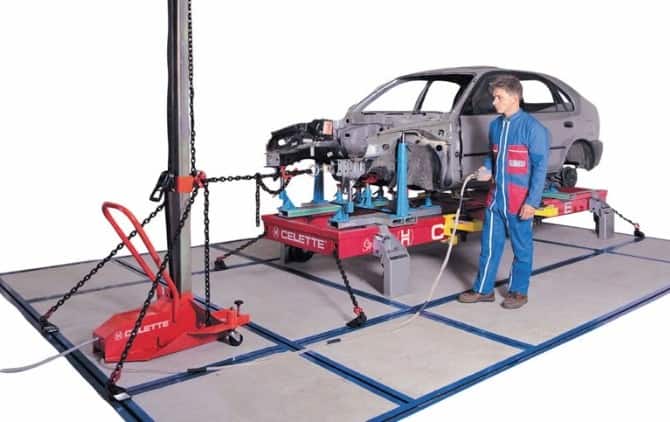
The CELETTE System 5000 is a modular floor repair system composed of heavy-duty steel rails integrated directly into the workshop floor.
These rails act as anchoring and force-transfer points, enabling technicians to straighten damaged vehicle bodies using hydraulic pulling and pushing equipment.
The system is primarily intended for:
• Passenger vehicles
• Light commercial vehicles (LCVs)
• Multi-damage scenarios requiring simultaneous force application
System 5000 is commonly configured in a 3-point pulling composition (System 3P), but it can be adapted with different accessories and pulling devices depending on workshop needs.
Core Repair Principle: Pull, Push, and Vector Forces
At the heart of the System 5000 concept is multi-directional force application. Instead of relying on fixed jigs or model-specific fixtures, technicians use the floor rails to create custom pulling vectors tailored to the damage scenario.
The repair process typically involves:
• Anchoring the vehicle securely to the floor rails
• Applying hydraulic force through rams, chains, and pulling towers
• Combining pulling, pushing, and vector correction simultaneously
This approach allows technicians to correct:
• Side impacts
• Front or rear structural displacement
• Twists and diamond-shaped distortions
• Progressive deformation along the vehicle body
The flexibility of this method is one of the key reasons floor systems remain so widely used across the industry.
System 5000 – 3 Point Composition (System 3P)
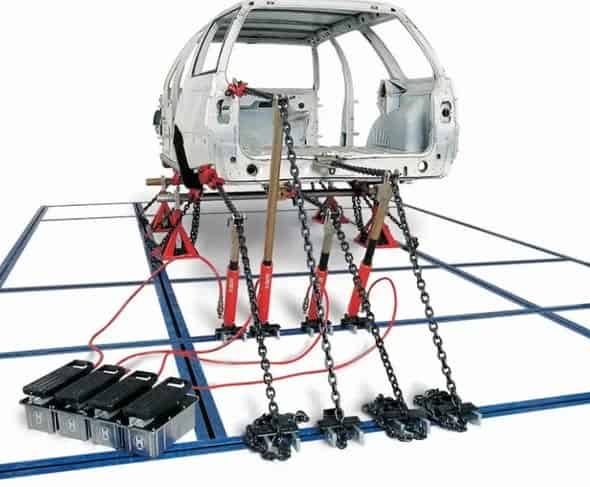
The 3-point composition (3P) is one of the most common configurations of the CELETTE System 5000. It is based on a simple but effective mechanical principle using three essential elements:
1. Fulcrum – the floor rail acting as the fixed reference point
2. Effort – the hydraulic cylinder applying force
3. Load – the anchoring clamps connected to the vehicle structure
In this configuration, the floor rails serve as the structural backbone, allowing force to be applied precisely where needed. By adjusting chain angles, clamp positions, and hydraulic pressure, technicians can fine-tune the direction and magnitude of the correction.
This setup is particularly effective for:
• Progressive straightening operations
• Complex damage requiring multiple pulling directions
• Situations where bench installation is not possible or practical
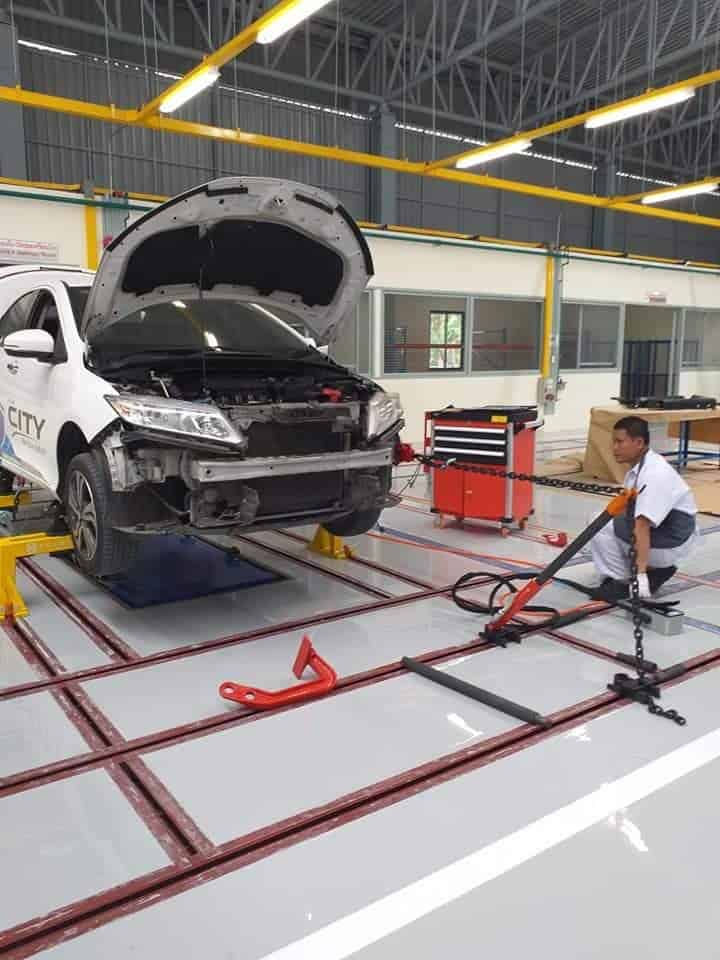
Key Components and Features
Hydraulic Power
The System 5000 utilizes hydraulic pumps, rams, and hoses to generate the force required for structural correction. Hydraulic power allows for:
• Smooth and controlled force application
• High pulling capacity
• Fine adjustment during the repair process
This ensures technicians can work progressively, reducing the risk of over-pulling or secondary damage.
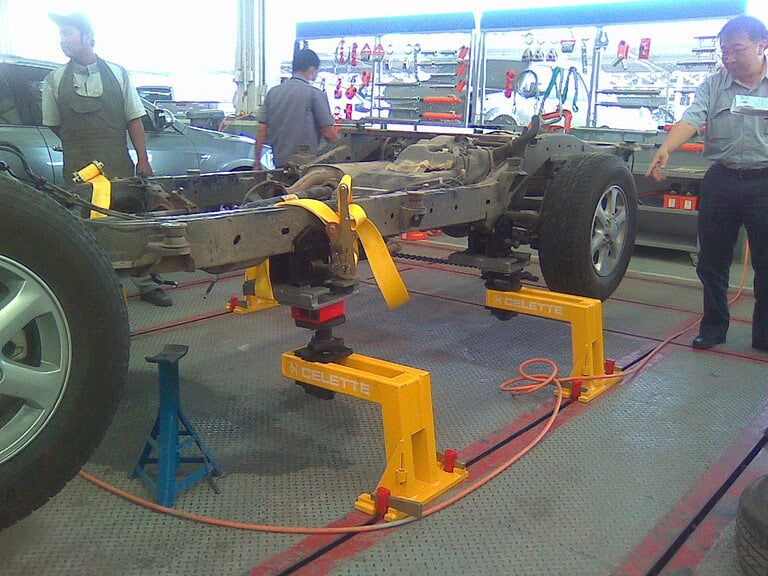
Anchoring Blocks and Clamps
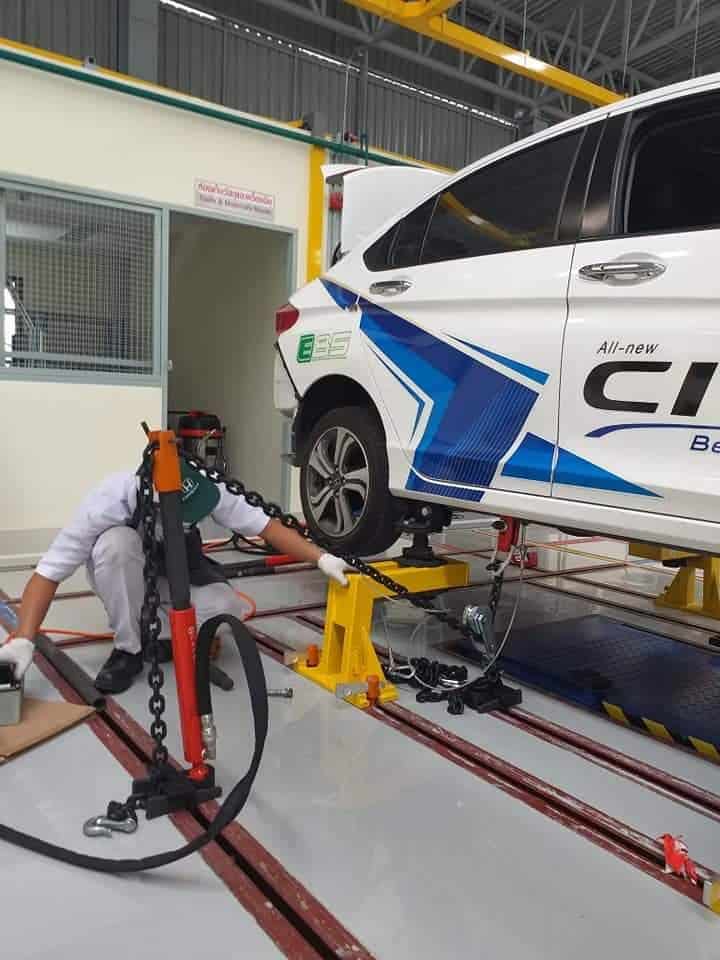
Specialized anchoring blocks and clamps secure the vehicle firmly to the floor rails. Proper anchoring is critical, as it provides:
• Stability during pulling operations
• Accurate force transfer to the vehicle structure
• Reduced risk of movement or slippage
CELETTE’s anchoring solutions are designed to adapt to various vehicle designs and structural profiles. This makes the System 5000 a dependable rail anchoring system that any body shop can rely on across a wide range of vehicles.
Versatility and Adaptability
One of the strongest advantages of the System 5000 is its versatility. The system can be adapted for:
• Different vehicle sizes
• Multiple damage scenarios
• Various repair techniques and workflows
Unlike model-specific jigs, the floor system allows workshops to handle a broad range of vehicles without frequent tooling changes.
Accuracy: Floor System vs Jig-Based Bench Systems
It is important to clearly distinguish the role of a floor system from that of a dedicated jig or bench system.
- Jig and bench systems, such as a dedicated auto body frame machine, provide higher dimensional accuracy, fixed reference points, and direct OEM measurement alignment.
- Floor rail systems, including System 5000, rely more heavily on technician skill, measurement tools, and experience.
While System 5000 is not as precise as jig-based bench systems, it remains:
- One of the most widely used repair methods globally
- Highly effective when combined with proper measuring equipment
- Ideal for workshops prioritizing flexibility and throughput
In real-world collision repair, many repairs do not require a full jig setup, making floor systems a practical and economical solution.
Why Floor Systems Remain Widely Used
Despite advances in jig and bench technology, floor systems like CELETTE System 5000 remain popular because they offer:
• Lower infrastructure complexity
• High adaptability
• Proven repair methodology
• Compatibility with multiple repair strategies
For many collision repair centers, the floor system represents a balanced solution between precision, cost, and operational flexibility.
Conclusion: A Proven and Practical Repair Solution
The CELETTE System 5000 Floor System is a time-tested, versatile solution for collision repair of passenger and light commercial vehicles. While it does not match the absolute precision of jig-based bench systems, it continues to be one of the most commonly used and effective repair methods worldwide.
By combining modular floor rails, hydraulic power, anchoring systems, and vector pulling techniques, System 5000 enables workshops to handle a wide range of structural repairs efficiently and reliably. For many repair environments, it remains an essential tool, bridging the gap between flexibility and structural correction in modern collision repair.
Frequently Asked Questions About the CELETTE System 5000
Q: What is the CELETTE System 5000?
A: It is a modular floor rail system for collision repair, built from heavy-duty steel rails set into the workshop floor. The rails act as anchoring and force-transfer points so technicians can straighten passenger cars and light commercial vehicles with hydraulic pulling and pushing.
Q: What is System 3P?
A: System 3P is the common 3-point pulling configuration of the System 5000. It works on a fulcrum, effort, and load principle: the floor rail is the fulcrum, a hydraulic cylinder supplies the effort, and anchoring clamps carry the load from the vehicle.
Q: How does the System 5000 anchor a vehicle?
A: Specialized anchoring blocks and clamps lock the vehicle to the floor rails, giving stability and accurate force transfer during a pull. As a rail anchoring system, it adapts to many vehicle profiles, which is why a body shop can use it across a broad mix of makes and models.
Q: Is the System 5000 as accurate as a jig or bench system?
A: No. A jig-based bench or auto body frame machine gives higher dimensional accuracy and fixed OEM reference points. The System 5000 relies more on technician skill and measuring tools, but it is highly effective when paired with proper measuring equipment.
Q: What vehicles is the System 5000 best suited to?
A: It is designed for passenger cars and light commercial vehicles, and it handles multi-damage scenarios that need force applied from several directions at once.