
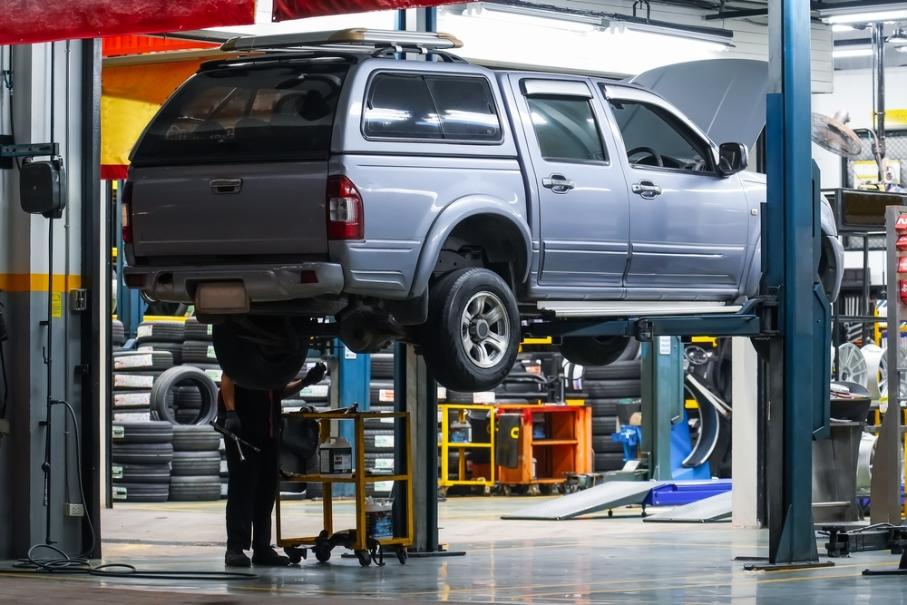
A truck’s frame distributes load, anchors the drivetrain, and determines how the vehicle handles a collision. Any damage to the frame that goes unaddressed rarely stays contained or cosmetic for long.
Frame damage on trucks also presents differently than on passenger cars. Standard light-vehicle procedures don’t account for the greater wheelbase, heavier curb weight, and body-on-frame construction that most commercial trucks and pickups carry.
Here’s what to know about the main damage types, rust repair considerations, welding and straightening techniques, cost ranges by service type, and how platform capacity affects repair quality.
Types of Truck Frame Damage Worth Knowing
Damage to a truck frame often manifests in a few types.
- Collision damage. This typically shows up as bending, twisting, or misalignment of the frame rails. Force from an impact travels along ladder-frame structures very differently than through a unibody, so the point of visible deformation is often not the point of maximum stress.
- Stress cracks. These develop at load concentration points, particularly where cross members attach to main rails, and usually accumulate gradually rather than appear after a single event.
- Secondary damage to alignment points further along the frame. Another pattern worth flagging, especially given that it is typically less noticeable. A truck can look straight from ten feet away and still be several millimeters out at the far rail.
Furthermore, pickups complicate assessment because of the cab-to-bed weight differential, where asymmetric loading distributes damage in less visible ways than with a passenger car.
Once damage is suspected anywhere along the rails, visual inspection alone is not enough. Measurement-based assessment against factory geometry is the only way to size the actual problem.
Truck Frame Rust Repair: Surface vs. Structural
The first call in truck frame rust repair is whether the corrosion is cosmetic or structural. Surface rust that hasn’t thinned the metal is a cleaning-and-coating job, but corrosion that has thinned or perforated load-bearing sections is a different case entirely.
- Surface rust removal follows a standard sequence: mechanical cleaning to strip loose material, chemical treatment to neutralize what remains, and surface prep before a protective coating.
- Structural repair goes further. Compromised sections are cut out, patches of equivalent-strength material are welded in, and reinforcement is added where the geometry demands it. Proper weld penetration is important, as a patch that looks clean but hasn’t fused deeply into the parent metal will fail earlier than the surrounding steel.
Internal cavity protection is where most rust repairs quietly go wrong. Prioritizing external coatings alone leaves the enclosed sections vulnerable, as these sections are usually where corrosion starts in the first place.
In humid climates common across Southeast Asia, road contamination and long wet seasons accelerate undercarriage corrosion in ways that dry-climate procedures underestimate. For this reason, extending service life requires anti-corrosion coatings to be applied inside the rails and not just outside.
Semi Truck Frame Repair Techniques
Crack repair on ladder-frame rails follows a specific sequence: drill a stop hole at the end of the crack to arrest propagation, then fill with multiple weld passes using an appropriate filler material. Controlled heat input throughout is important, as too much heat introduces new stress zones, and the crack can circumvent the repair.
When a crack repair alone isn’t enough, reinforcement plates, sometimes called fish plates or doubler plates, are installed over the affected section. The material grade needs to match the parent rail. With full-flange welding along the plate perimeter, this distributes load rather than concentrating it at the weld edges.
If damage is severe, this moves the work into frame section replacement, which means precise cut location at designated splice points and alignment fixture verification before final welds go in. Straightening on commercial frames also demands greater pulling capacity than passenger-car work, often with multi-directional force applied simultaneously.
All of this must fall within DOT compliance and manufacturer specifications. Repairs that fail inspection typically need to be redone.
Truck Frame Repair Cost by Service Type
The cost of truck frame repairs varies widely by service category.
- Crack welding sits at the lower end.
- Straightening a bent frame is a middle-tier job.
- Rust repair ranges from low to moderate depending on how deep the corrosion runs.
- Reinforcement plate installation and section replacement sit higher.
- Full frame replacement is the most expensive path, typically several times the cost of a targeted repair.
Variables that shift truck frame repair costs include vehicle type, damage severity, labor rates, and whether OEM or aftermarket parts are specified. The repair-versus-replacement decision is not purely a cost calculation either, as other important factors include the structural condition, planned vehicle retention, and insurer requirements.
However, certain conditions like multiple compromised sections, rust perforation running along the structural length, and rail collapse point toward replacement as the better path. Repairing around those conditions can produce a truck that measures well but behaves unpredictably under real load.
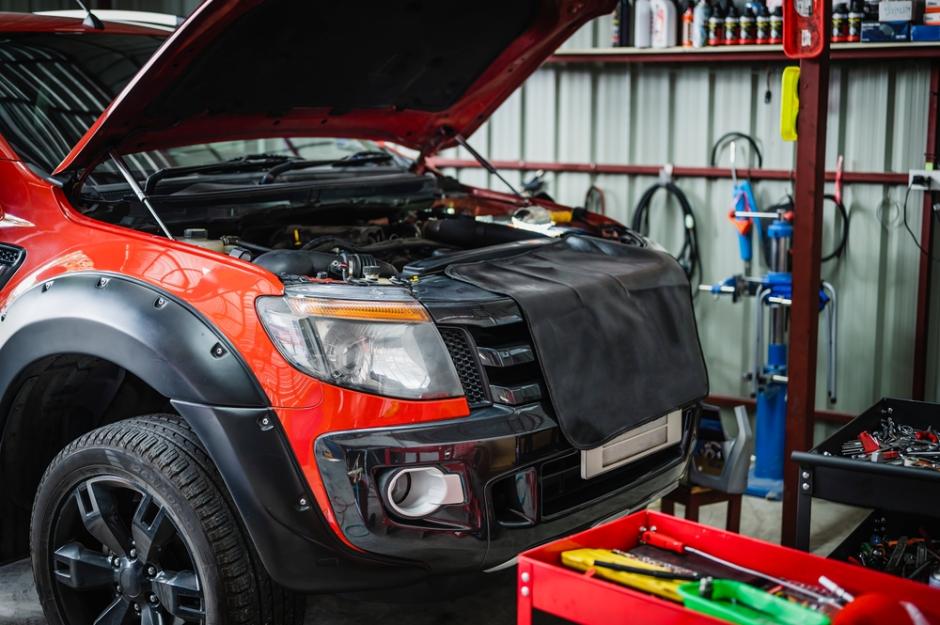
Standard passenger-car benches are inadequate for extended-wheelbase trucks and light commercial vehicles. Without a platform length that matches the vehicle, the vehicle overhangs, support is incomplete, technician access is restricted, and full-length measurement becomes unreliable. A pickup frame alignment bench for a modern pickup needs enough length for stable four-point anchoring and measurement access across the entire wheelbase, not just the section directly under the lift.
Pulling capacity is the second consideration. Body-on-frame trucks require more force than unibody passenger vehicles, and a full frame truck clamp setup has to hold the structure without slipping under load. Double-scissor lift design also matters here, as it distributes support across the platform, keeping the bench level under asymmetrically loaded trucks where cab and bed weights differ. All this then needs to be topped off with the right integration of measurement systems.
Beyond the equipment, pre- and post-repair dimensional verification against OEM data matters as well, as it provides the documentation that insurers, fleet operators, and OEM programs increasingly require.
Choosing the Right Bench for Truck Frame Repair Work
Shops that regularly handle pickups, vans, and light commercial vehicles need a platform built for that workload, not one adapted from passenger-car dimensions. At Celette, our Rhone XL platform is engineered specifically for this segment. It carries up to 5,500 kg on a 5,800 mm platform (7,030 mm including ramps), giving full-vehicle access for extended-wheelbase vehicles.
The double scissor lift design provides stable, tilt-free elevation for trucks where cab and bed weight distribution is uneven. The bench is compatible with Celette’s NAJA 3D and Eagle measuring systems, and it works with MZ, MZ+, and Cameleon universal jig systems. On-ground and in-ground installation options are available, with working height reaching up to 1,200 mm for comfortable underbody access.
Set Up Your Shop for Better Truck Frame Work
Truck frame repair spans a range from surface rust repair to full section replacement, and each category demands correct diagnosis, technique, and equipment. Using undersized or unsuitable platforms without a proper pickup frame alignment bench or full frame truck clamp setup compounds repair difficulty and limits the accuracy of dimensional verification.
At Celette, our Rhone XL platform is purpose-built for the extended-wheelbase vehicle segment, combining 5,500 kg lifting capacity with double-scissor stability, full measuring system compatibility, and universal jig support to meet the demands of professional truck frame repair.
Explore options for extra-long drive-on benches at Celette today. Contact us at [email protected] to discuss your shop’s requirements to see full specifications, or view our wider Rhone bench range for other vehicle mixes.
References:
Challenges of heavy-duty truck frame repair. Retrieved July 14, 2026, from https://www.truckpartsandservice.com/maintenance/service-and-repair/article/14989462/challenges-of-heavyduty-truck-frame-repair
Federal Motor Vehicle Safety Standards, Commercial Vehicles. Retrieved July 14, 2026, from https://www.fmcsa.dot.gov/regulations/title49/section/393.1
Frequently Asked Questions About Truck Frame Repair
Q: Can all truck frame damage be repaired?
A: Not always. Minor bends, isolated cracks, and surface rust respond well to professional repair techniques, but damage involving multiple compromised sections, extensive rust perforation, or rail collapse usually requires full frame replacement to preserve structural integrity and safety.
Q: How is truck frame rust repair different from repairing a passenger car?
A: The principles overlap, but truck frames carry heavier loads and have larger enclosed rail sections. Internal cavity protection is more important, and structural patches must match the original rail’s strength grade. Localized humidity and undercarriage exposure also make prevention a bigger factor than on a passenger car.
Q: What drives truck frame repair cost?
A: The main variables are vehicle type, damage severity, labor rates, and whether OEM or aftermarket parts are used. Service category matters too. Crack welding sits at the lower end of the range, straightening in the middle, and full frame replacement at the top.
Q: Is welding safe on a semi truck frame?
A: Yes, when it’s performed by qualified technicians using approved filler materials, controlled heat input, correct penetration depth, and any reinforcement specified by the manufacturer. All work should comply with DOT regulations and OEM repair guidance.




