Key Takeaways
- A tram gauge is a simple, affordable, and universally applicable manual measuring tool that checks distances between fixed reference points on a vehicle body or chassis, which is why it remains one of the most widely used tools in collision repair.
- As an auto body tram gauge, it works by distance comparison rather than absolute coordinates, so its accuracy depends entirely on the quality of the OEM reference data it is measured against.
- Traditional use of the tram gauge tool has clear limits: dependence on accurate data, no visual guidance, and no digital traceability for insurance or OEM compliance.
- Celette WebTools AI is tool-agnostic, letting body shops pair Celette’s OEM-level vehicle database with any tram gauge auto body setup on the market, as well as with electronic systems such as the car frame measurement tool NAJA 3D.
- A tram gauge alone cannot replace electronic measuring for full ADAS validation or OEM-certified alignment, but supported by WebTools AI it becomes far more reliable for pre-repair and in-process verification.
Table of Contents
Accurate dimensional control is the foundation of professional collision repair. Before advanced electronic measuring systems became widespread, body shops around the world relied on tram gauges (also known as tracking gauges) as a primary tool to verify vehicle body dimensions. Even today, tram gauges remain one of the most widely used measuring tools in collision repair due to their simplicity, affordability, and universal applicability.
However, modern vehicles have become significantly more complex. Mixed materials, high-strength steels, aluminum structures, and the widespread integration of ADAS (Advanced Driver Assistance Systems) have dramatically increased the precision requirements for structural repairs. In this evolving environment, traditional measuring tools must be supported by accurate data, clear reference points, and intelligent workflows.
This is where Celette WebTools AI introduces a critical evolution: enabling body shops to use Celette’s OEM-level vehicle database with any tram or tracking gauge on the market, combining the simplicity of manual measurement with the intelligence of digital data.
What Is a Tram Gauge?
A tram gauge is a manual measuring tool designed to check distances between fixed reference points on a vehicle body or chassis. Typically telescopic and adjustable, it allows technicians to compare critical dimensions.
Tram gauges do not measure in absolute coordinates. Instead, they rely on distance comparison between two known points, often referenced against manufacturer specifications.
Because of their simplicity, tram gauges require no software, calibration, or power source, making them extremely robust and universally accessible. Used as a frame measuring tool, the auto body tram gauge gives technicians a quick way to confirm whether a body or chassis sits within specification.
Tram gauge video:
Global Use of Tram Gauge and Tracking Gauge
Despite the availability of advanced 3D electronic measuring systems, tram gauges are still used worldwide in:
- Independent collision repair shops
- Insurance assessment and preliminary inspections
- Training environments
- Markets where electronic systems are not economically viable
- Quick verification checks during or after repairs
In many regions, tram gauges remain the first step in damage assessment, allowing technicians to quickly identify whether structural deviation exists before committing to more complex repair processes.
They are also commonly used alongside frame benches and floor systems, particularly during pulling operations, to verify dimensional progress in real time.
Limitations of Traditional Tram Gauge Measurement
While tram gauges are practical and reliable, they also have inherent limitations that become more evident with modern vehicle designs.
Key Limitations :
1. Dependence on Accurate Data
Tram gauges are only as accurate as the dimensional data they reference. Without reliable OEM measurements, results can be misleading.
2. Lack of Visual Guidance
Traditional tram gauge use requires technicians to manually interpret diagrams or paper data, increasing the risk of human error.
3. No Digital Traceability
Measurements are not automatically recorded, making documentation for insurance or OEM compliance difficult.
These limitations do not make tram gauges obsolete, but they highlight the need for intelligent data integration.
The Importance of Accurate Measurement Data
Modern collision repair is no longer just about restoring visual appearance.
Structural accuracy directly impacts:
- Vehicle safety
- Passive and active safety systems
- ADAS functionality
- OEM warranty compliance
- Legal and insurance liability
Even small dimensional deviations can lead to improper sensor alignment, steering geometry issues, or incorrect crumple-zone behavior in future impacts.
This is why access to reliable, OEM-based measurement data is now more critical than the measuring tool itself. Pairing an auto body tram gauge with trusted reference data is what turns a basic check into a dependable structural verification.
Introducing Celette WebTools AI
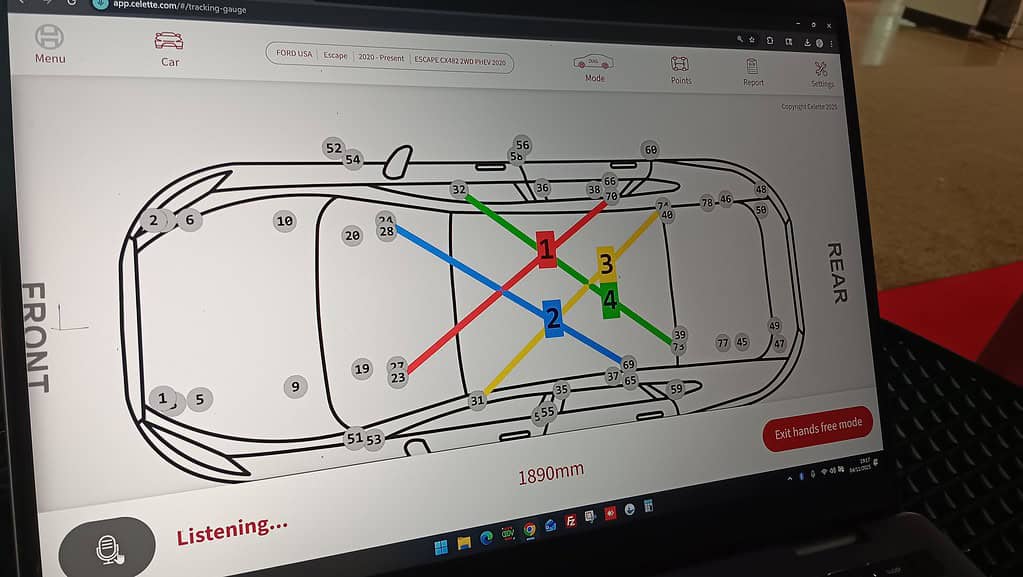
Celette WebTools AI is a cloud-based vehicle data and repair-support platform designed to provide intelligent access to Celette’s extensive vehicle database, developed over decades through OEM collaboration, homologation programs, and real-world collision-repair experience.
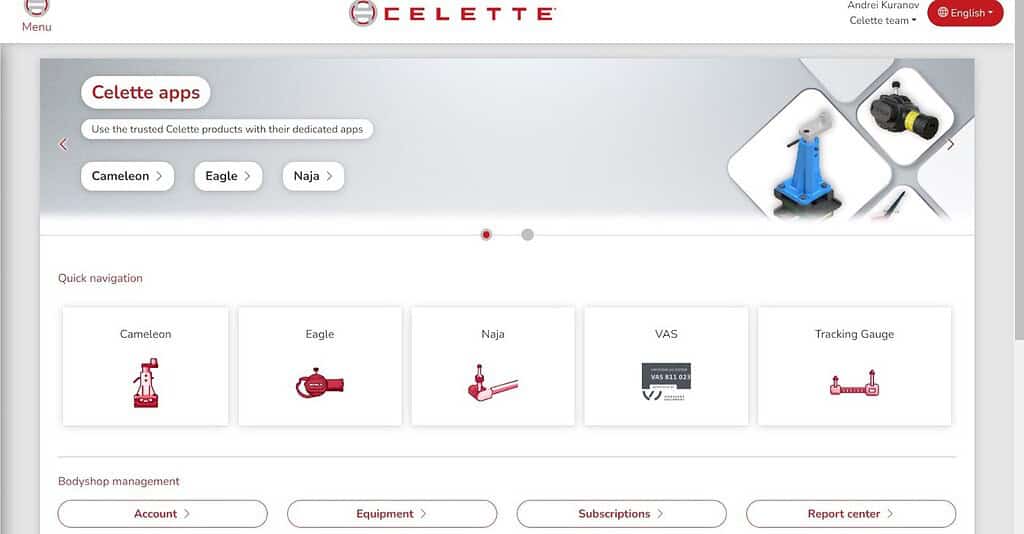
Unlike traditional measuring software that is strictly tied to specific hardware, WebTools AI is tool-agnostic, allowing the same database and workflows to support a wide range of measuring and repair solutions. This includes full integration with Celette electronic measuring systems such as EAGLE and NAJA 3D, as well as CAMELEON universal jig systems, while also remaining compatible with tram gauges, tracking gauges, and selected bench systems from other manufacturers.
Beyond digital measurement, WebTools AI also supports physical repair solutions, including the option to order printed or manufactured jigs directly from Celette, ensuring accurate positioning of vehicles on benches and floor systems when jig-based repair methods are required.
Core Purpose of WebTools AI
- Provide accurate OEM-based structural reference data across multiple vehicle types
- Support electronic measuring (EAGLE, NAJA 3D), jig-based repair (CAMELEON), and manual measurement tools
- Enable compatibility with selected third-party benches and traditional tram or tracking gauges
- Simplify technician workflow by centralizing data, references, and repair logic
- Improve measurement consistency, repeatability, and overall repair reliability
Using Celette WebTools AI with Any Tram Gauge
One of the most powerful features of Celette WebTools AI is that Celette’s vehicle database can be used with any tram gauge or tracking gauge on the market.
This fundamentally changes how manual measuring tools can be applied in modern repair environments.
How It Works in Practice
1. Vehicle Selection
The technician selects the exact vehicle model, year, and variant in WebTools AI.
2. Reference Point Identification
WebTools AI displays clear, structured reference points derived from Celette’s database.
3. Manual Measurement with Tram Gauge
The technician measures the distance between the specified reference points using their existing tram gauge tool.
4. Comparison and Verification
Measured values are compared against the reference dimensions provided by WebTools AI.
This workflow allows body shops to maintain their existing tools while significantly upgrading the quality and reliability of their measurement process.
Why This Matters for Body Shops Worldwide
Body shops are no longer forced to invest immediately in specific electronic measuring hardware to benefit from accurate data. Any existing tram gauge auto body workflow becomes more powerful when paired with Celette WebTools AI.
Improved Accuracy Without Complexity
Technicians gain access to professional-grade reference data without changing their habits or workflows dramatically. This lowers resistance to adoption and reduces training time.

Better Documentation and Repair Confidence
Even when using manual tools, structured reference data improves repair confidence and supports clearer communication with insurers, auditors, and OEM programs.
Tram Gauges, ADAS, and Modern Repair Reality
It is important to be clear: tram gauges alone cannot replace electronic measuring systems when it comes to full ADAS validation or OEM-certified structural alignment. For that level of accuracy, an electronic car frame measurement tool such as NAJA 3D is required.
However, when supported by Celette WebTools AI:
- Tram gauges become more reliable for structural checks
- Pre-repair and in-process verification improves
- Risk of gross dimensional errors is reduced
- Decisions about further repair steps are better informed
In this sense, WebTools AI acts as an intelligent bridge between traditional tools and modern repair standards.
Conclusion
Tram gauges remain one of the most widely used and trusted measuring tools in collision repair worldwide. Their simplicity, durability, and universal applicability ensure they will continue to play a role—especially for preliminary checks and in-process verification.
However, in an era of increasingly complex vehicle structures and ADAS-driven safety requirements, data quality matters more than ever.
By enabling Celette’s professional vehicle database to be used with any tram or tracking gauge on the market, Celette WebTools AI transforms a traditional manual tool into a smarter, more reliable measuring solution.
This approach allows body shops to preserve proven tools while aligning with modern repair standards—bridging the gap between traditional craftsmanship and digital precision.
Bridge the gap between traditional tools and digital precision. Discover how Celette WebTools AI empowers body shops to use reliable OEM data with any Tram Gauge, enhancing accuracy and workflow without the need for immediate electronic hardware investment.
Frequently Asked Questions About Tram Gauge Collision Repair
What is a tram gauge?
A tram gauge is a manual measuring tool, usually telescopic and adjustable, designed to check distances between fixed reference points on a vehicle body or chassis. It lets technicians compare critical dimensions against manufacturer specifications during collision repair.
How does an auto body tram gauge actually measure damage?
A: An auto body tram gauge does not measure in absolute coordinates. Instead, it relies on distance comparison between two known points, which are then checked against reference dimensions to confirm whether structural deviation exists.
Q: Why is the tram gauge still so widely used in collision repair?
A: The tram gauge requires no software, calibration, or power source, which makes it extremely robust, affordable, and universally accessible. It remains common in independent shops, insurance assessments, training, quick verification checks, and markets where electronic systems are not economically viable.
Q: What are the limitations of a traditional frame measuring tool like this?
A: As a manual frame measuring tool, a tram gauge is only as accurate as the data it references, offers no built-in visual guidance, and does not automatically record measurements. That makes documentation for insurance or OEM compliance harder without supporting data.
Q: Can a tram gauge tool be used with Celette WebTools AI?
A: Yes. One of the key features of Celette WebTools AI is that its OEM-based vehicle database can be used with any tram gauge tool or tracking gauge on the market. The technician selects the vehicle, views structured reference points, measures manually, then compares the values against the database.
Q: Can a tram gauge auto body check replace an electronic measuring system?
A: No. A tram gauge auto body check alone cannot replace electronic measuring systems for full ADAS validation or OEM-certified structural alignment. For that level of accuracy, an electronic car frame measurement tool such as NAJA 3D is required. Supported by WebTools AI, however, a tram gauge becomes more reliable for pre-repair and in-process checks.
Q: When is a tram gauge used during the repair process?
A: In many regions, the tram gauge is the first step in damage assessment, used to quickly identify structural deviation before committing to more complex repairs. It is also used alongside frame benches and floor systems during pulling operations to verify dimensional progress in real time.
Q: Why does accurate measurement data matter more than the tool itself?
A: Structural accuracy directly affects vehicle safety, ADAS functionality, OEM warranty compliance, and insurance liability. Because even small deviations can cause problems, access to reliable OEM-based data is now more critical than the measuring tool alone, which is why pairing an auto body tram gauge with trusted reference data matters.