

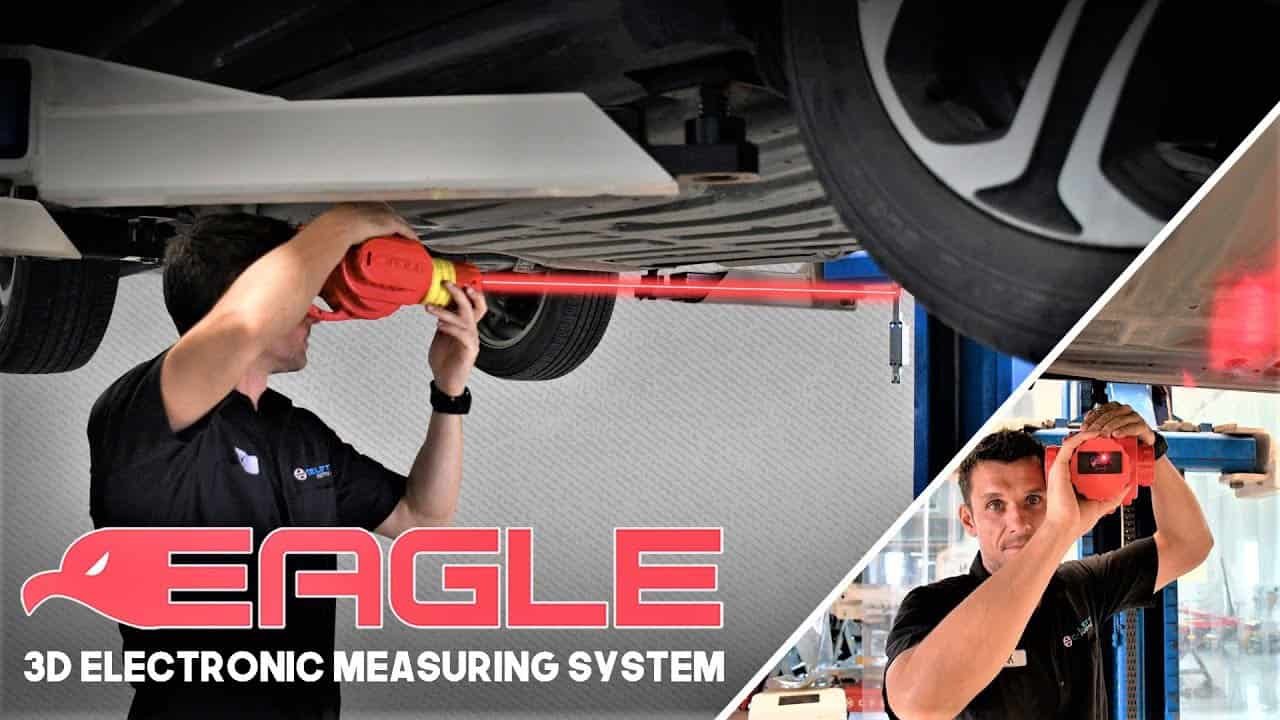
As vehicles equipped with Advanced Driver Assistance Systems become increasingly sophisticated, the collision repair industry faces evolving precision requirements. Electronic measuring systems, while technologically advanced, present theoretical accuracy considerations that, according to industry experience, may range from 3 to 15 millimeters—potentially challenging modern vehicle repair standards. This analysis explores industry observations about measurement-dependent repair methods and demonstrates why mechanical repair systems may offer enhanced reliability for ensuring structural integrity and ADAS functionality.
Legal Disclaimer: This article presents industry observations and theoretical analysis based on professional experience. The views expressed are those of industry professionals and do not constitute definitive scientific conclusions. Readers should conduct their own evaluation of repair methods and consult manufacturer specifications for their specific applications. No claims of superiority over competing systems are intended as absolute statements, but rather as professional observations based on decades of industry experience.
The Evolution of Precision Requirements in Modern Vehicles
From Traditional Tolerances to Zero-Tolerance Standards
The automotive repair industry has undergone a significant transformation in precision requirements that influences every collision repair decision. This evolution reflects technological advancement and changing safety standards in modern vehicle design.

Modern ADAS-equipped vehicles represent a new level of precision requirements, where sensor positioning accuracy directly influences system functionality and occupant safety. The transition from traditional ±5mm tolerances to zero-tolerance requirements for critical mounting points represents a fundamental shift in repair methodology considerations.[rts.i-car+1]
The Critical Foundation: Structural Integrity and Safety Systems
Understanding the Interconnected Safety Framework
Modern vehicle safety depends on the precise interaction between structural elements and advanced safety systems. The vehicle’s structural integrity serves as the foundation upon which all safety systems—including ADAS—must function correctly.
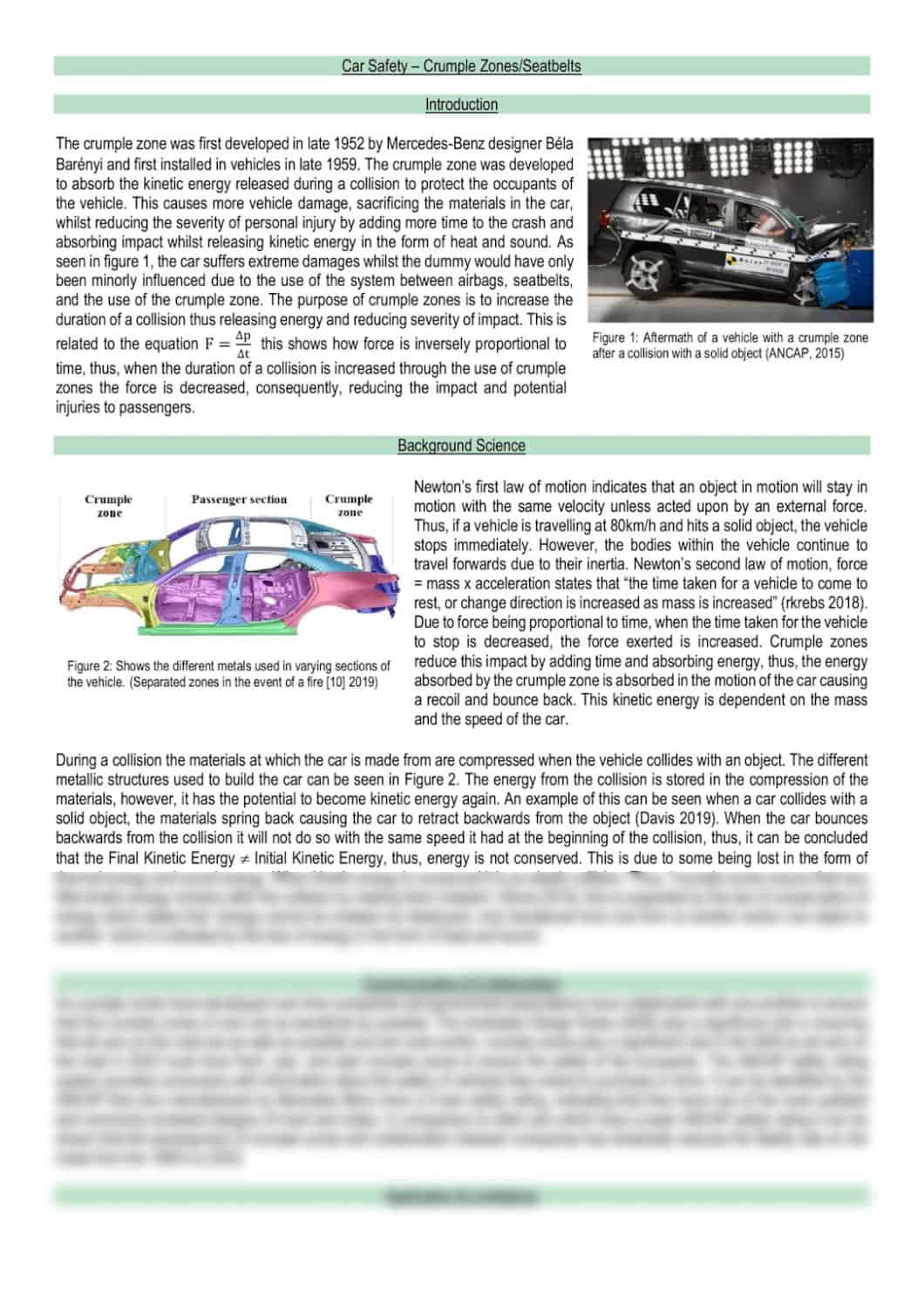
Crumple zones and structural elements work in coordination with ADAS sensors to provide comprehensive occupant protection. When structural damage compromises these carefully engineered safety zones, the restoration must achieve the same precision that existed during original manufacturing. Any deviation from OEM specifications can affect not only crash protection effectiveness but also the calibration and functionality of integrated safety systems.
Industry Observations on Electronic Measurement Systems
Professional Experience and Theoretical Considerations
While comprehensive empirical studies quantifying cumulative error ranges in automotive collision repair measurement systems remain limited, industry professionals consistently observe precision considerations that may compound throughout the repair process. These observations, representing decades of practical experience across repair facilities worldwide, suggest areas for further investigation.[nationalcollisionrepairer]
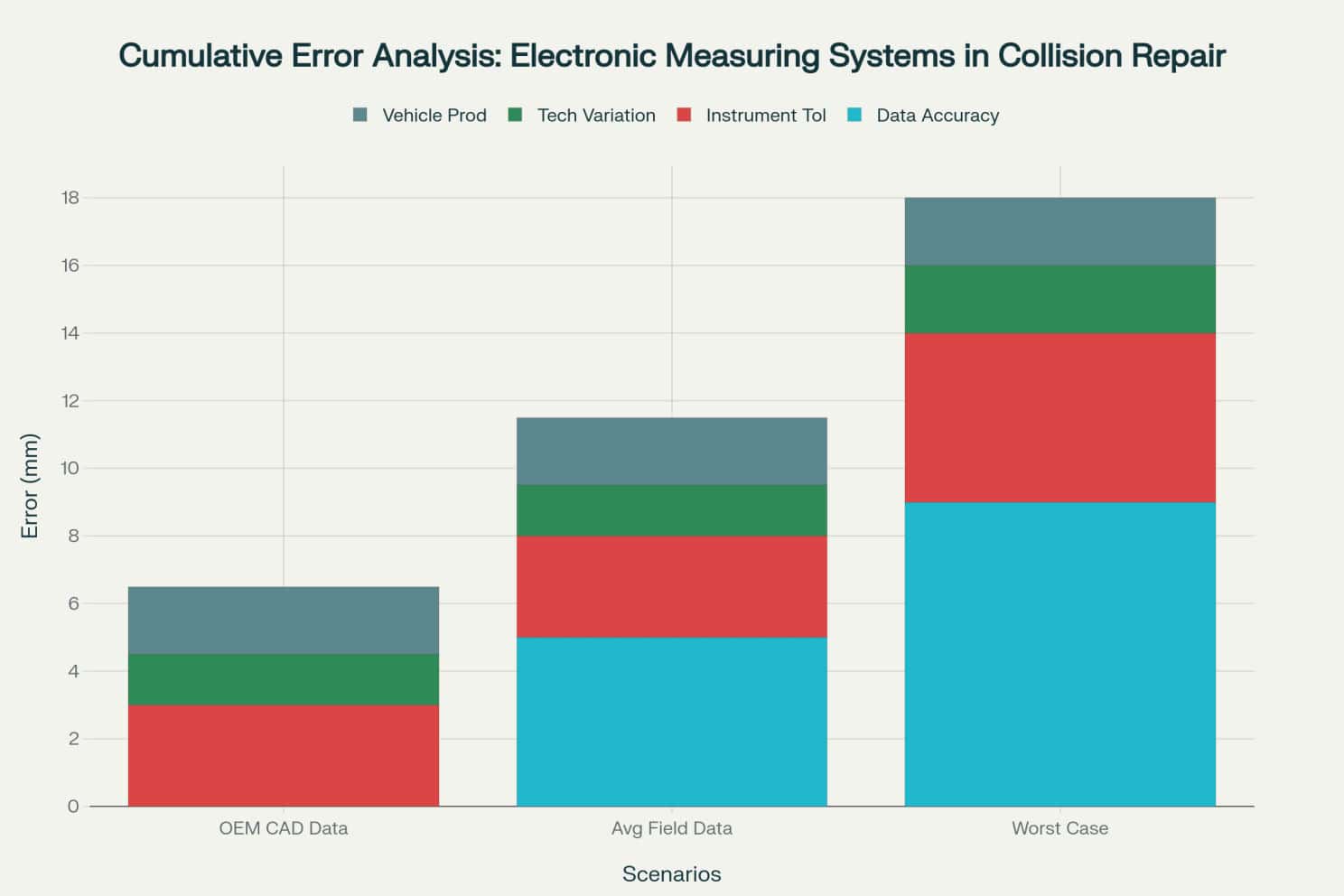
Theoretical analysis based on industry experience indicates that measurement uncertainties may accumulate through several potential sources:
Data Source Considerations: When manufacturers don’t provide direct OEM CAD drawings, measurement system databases may contain variations that industry professionals observe could potentially range from 5 to 9 millimeters in some applications.
Instrument Tolerance Factors: Electronic measuring equipment typically maintains tolerances that industry experience suggests may vary between 1 and 5 millimeters depending on the specific system and application.
Operational Variables: Industry observation indicates that technician skill variations and environmental factors may contribute additional uncertainty, though formal studies quantifying these effects in collision repair contexts would be valuable.
Manufacturing Tolerance Integration: Vehicle production tolerances add complexity, with industry professionals estimating approximately 2 millimeters of potential variation from nominal specifications in typical applications.
Theoretical Accuracy Considerations
In theoretical scenarios, these industry-observed factors could potentially accumulate to create measurement uncertainties that may challenge the tolerance requirements for modern ADAS-equipped vehicles.[rts.i-car]
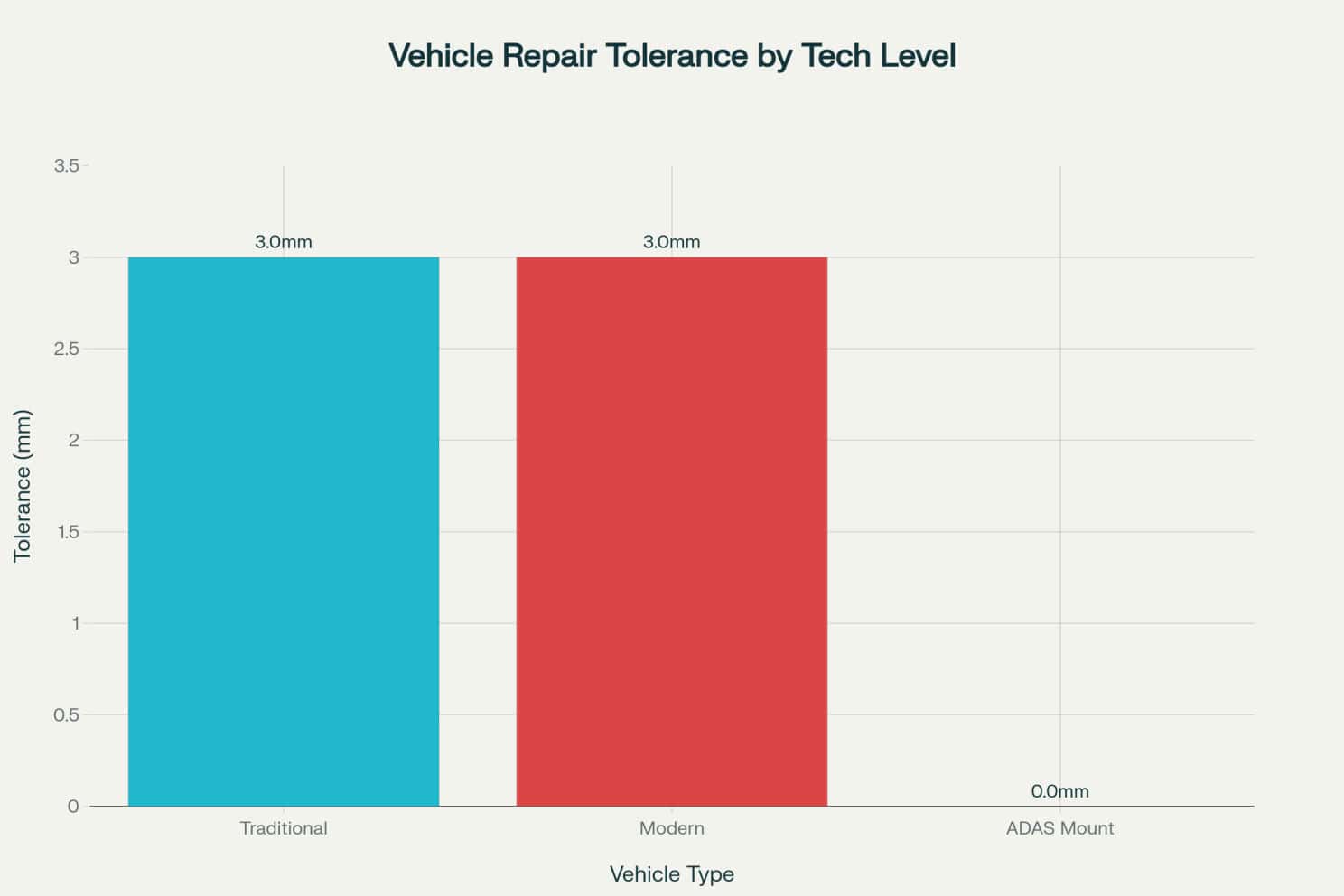
However, this analysis represents theoretical considerations based on professional observation rather than controlled scientific study.
Even in optimal theoretical scenarios, industry experience suggests measurement uncertainty considerations that may exceed zero-tolerance requirements for ADAS sensor mounting points established by industry standards. These observations highlight potential areas for enhanced precision in measurement-dependent repair methods.[rts.i-car+1]
Time Efficiency Considerations in Repair Methods
Operational Efficiency Observations
Industry experience reveals operational efficiency differences between repair methodologies that merit consideration in repair planning. According to professional observations, certain measurement-dependent repairs may require significantly more time than equivalent repairs using mechanical systems.
This time differential becomes particularly evident in complex repairs requiring multiple fixture points. For example, using universal mechanical systems, experienced technicians have demonstrated positioning vehicles on 10 fixtures or holding devices in less than 40 minutes. Equivalent positioning tasks using certain measurement-dependent approaches may require considerably more time—often exceeding two hours even for fewer fixture points.
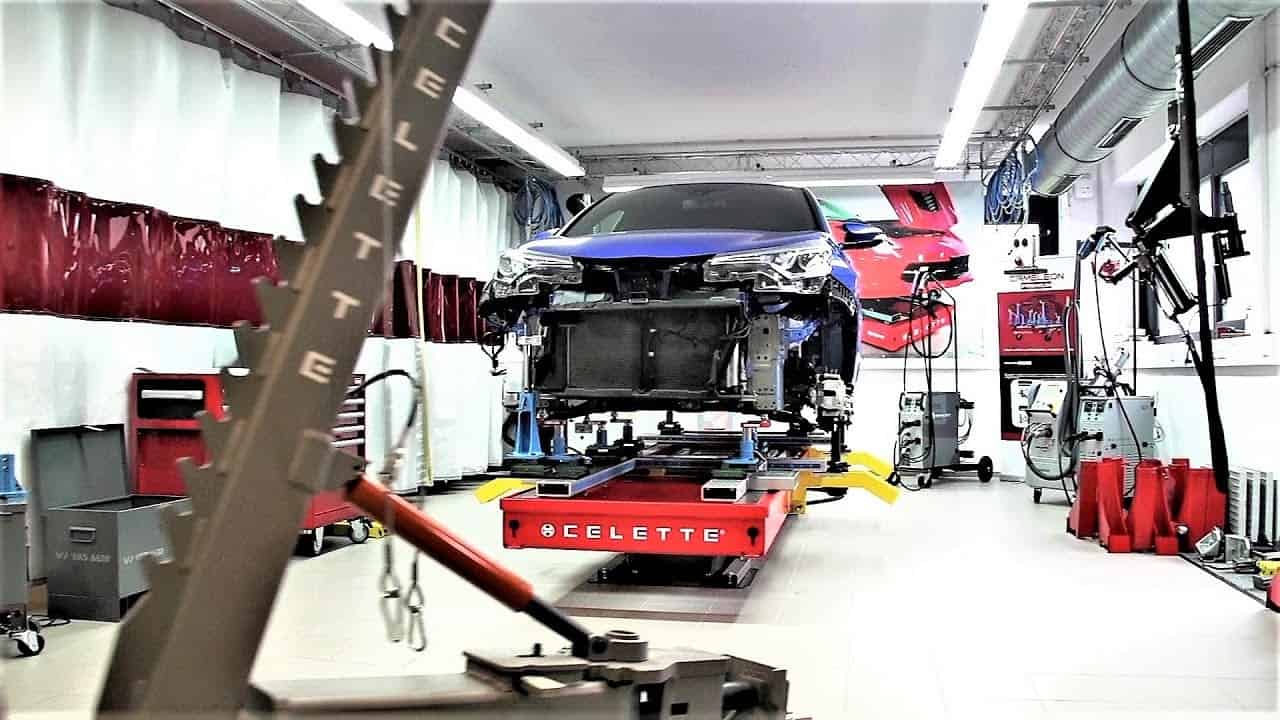
Blue car on a Celette frame machine undergoing collision repair in a professional workshop youtube
The observed time efficiency differences may stem from several factors:
- Direct positioning capabilities without iterative measurement verification cycles
- Simultaneous multi-point setup rather than sequential measurement-based adjustments
- Immediate mechanical confirmation of proper positioning
- Reduced verification cycles that may streamline technician workflow
This efficiency consideration represents not just operational convenience, but potential economic advantages that may offset equipment investment costs while providing enhanced repair precision.
Mechanical System Advantages: Industry Performance Observations
Evidence-Based Mechanical Performance
Dedicated mechanical fixtures designed for specific vehicle models, as well as universal mechanical systems based on established engineering principles, demonstrate measurable advantages through direct mechanical references rather than measurement-dependent positioning. Mechanical precision benefits from decades of documented successful implementation across diverse repair applications.
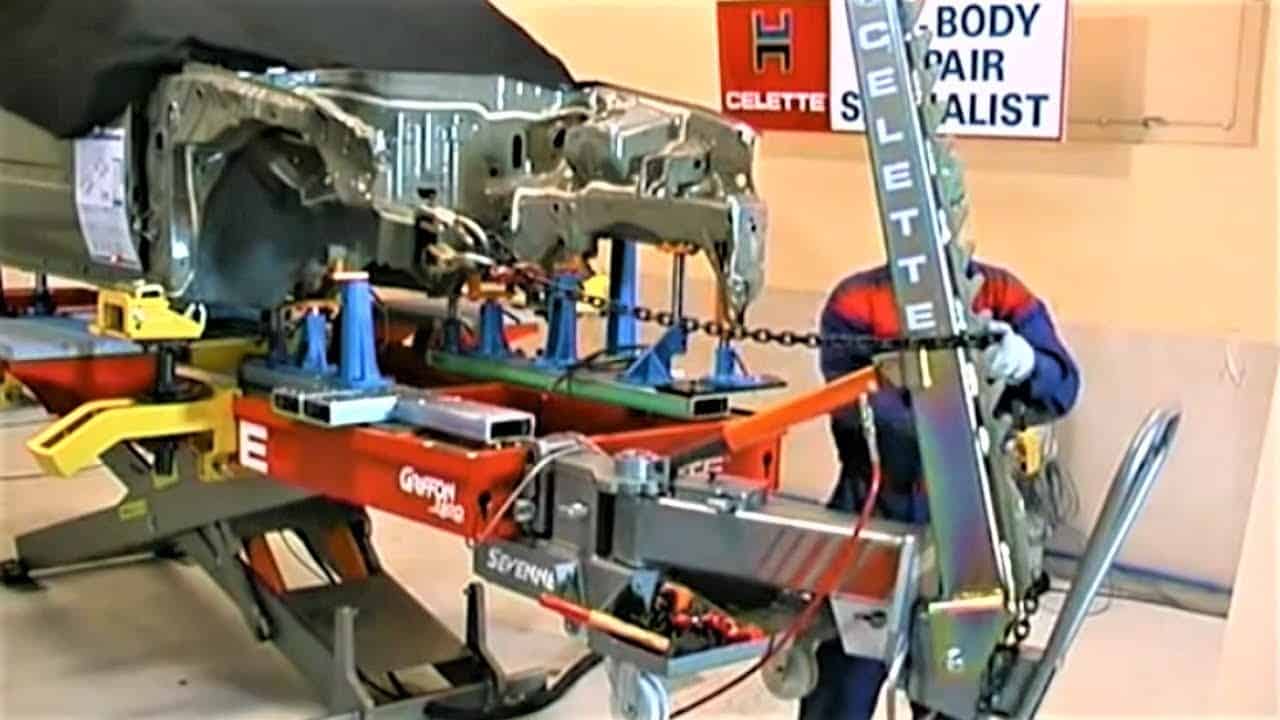
Professional mechanical repair systems operate through established principles:
- Direct replication of original manufacturing fixture conditions
- Fixed mechanical datum points independent of collision-induced distortions
- Calibrated force application with established precision capabilities
- Mechanical verification through direct engagement rather than measurement interpretation
Dedicated and Universal Mechanical Approaches
Industry implementation demonstrates that both approaches can achieve enhanced precision:
Dedicated Fixtures:
- Documented performance across specific vehicle platforms using verified OEM manufacturing data
- Demonstrated elimination of interpretation variables through direct mechanical integration
- Established track record of achieving OEM specifications consistently
Universal Mechanical Systems:
- Demonstrated reliability across multiple vehicle platforms using fundamental geometric principles
- Proven consistency through mechanical verification rather than database dependencies
- Documented precision maintenance across diverse repair scenarios
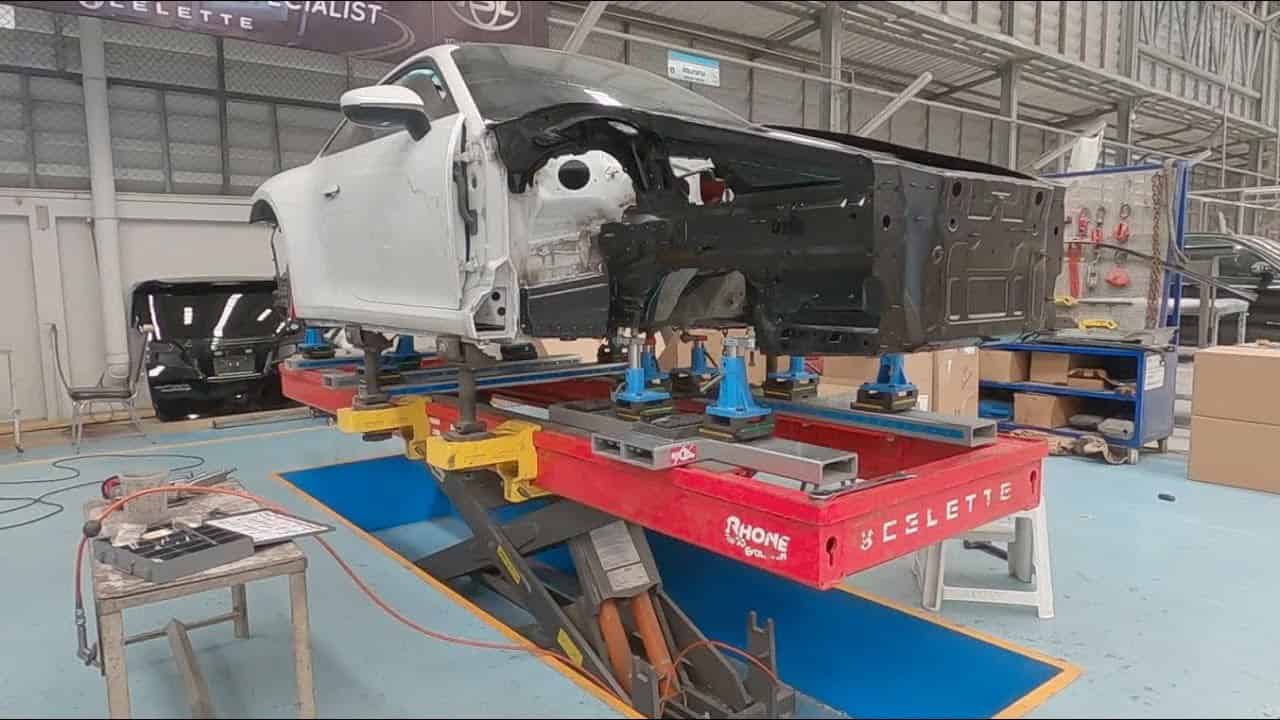
The key differentiating characteristic appears to be the reliance on mechanical methods rather than measurement interpretation, potentially providing enhanced confidence in repair precision.
Industry Dynamics and Market Considerations
Economic Factors in Repair Method Selection
Insurance companies and industry stakeholders face legitimate economic considerations that influence repair method adoption. These factors reflect real market dynamics:[autobodynews+1]
- Capital investment considerations for repair facility equipment
- Training requirements for technician development
- Operational efficiency needs for competitive repair cycles
- Process complexity considerations for facility management
However, industry observations suggest that comprehensive cost analysis may benefit from considering long-term quality and efficiency implications.
Manufacturer Perspectives and Standards Evolution
Original equipment manufacturers navigate complex technical and market considerations while working to maintain safety standards. According to industry observations, manufacturers may face multiple considerations:[mercedesblog+1]
- Market positioning requirements affecting various business decisions, including considerations related to maintaining favorable insurance classification ratings which can influence vehicle affordability and competitiveness
- Technical communication challenges across diverse repair facility capabilities
- Resource allocation decisions regarding training and support program development
- Industry standardization needs requiring balance between specifications and practical implementation
Progressive manufacturers increasingly recognize that supporting comprehensive mechanical repair standards may serve long-term brand protection and customer safety objectives.
Professional Performance Observations
ADAS System Precision Requirements

According to industry professional observations, vehicles repaired using certain measurement approaches may exhibit performance variations:[reparlab+1]
Sensor Positioning Considerations: Industry experience suggests that measurement-dependent repairs may potentially result in:
- Detection zone variations that may differ from optimal specifications
- System performance characteristics that may require additional calibration attention
- Long-term calibration stability considerations
Structural Performance Factors: Professional observations indicate potential considerations regarding:
- Stress distribution patterns that may vary from original design intent
- Handling characteristics that may benefit from post-repair verification
- Durability aspects that may benefit from precise dimensional restoration
Professional Standards Development
Industry professionals increasingly recognize that certain measurement-dependent methods may not consistently achieve the precision required for modern vehicles equipped with advanced safety systems, though formal validation through controlled studies would enhance understanding.
Professional facilities are adopting mechanical precision approaches based on documented successful implementation rather than theoretical measurement capabilities alone.
Legal Precedent Considerations
The John Eagle Case: Industry Learning
The John Eagle Collision Center case provides important guidance to the collision repair industry. This significant litigation resulted in substantial damages when specified repair procedures were not followed, establishing several important precedents:
- Repair facilities bear responsibility for repairs that meet OEM specifications and industry standards
- Proper procedure compliance represents essential professional practice
- OEM repair procedures represent important technical standards for professional implementation
- Adherence to manufacturer specifications constitutes professional best practice with important quality implications
The implications suggest that precision-focused repairs, designed to consistently meet OEM specifications, may provide enhanced professional confidence and customer satisfaction.
Enhanced Mechanical Precision Solutions
Demonstrated Mechanical System Performance
The collision repair industry has access to established mechanical systems that provide documented successful implementation across diverse applications. Professional mechanical repair systems offer proven methods for achieving required precision while potentially reducing repair time.
Model-Specific Solutions: Dedicated fixtures with documented performance records in replicating original assembly conditions, potentially eliminating interpretation variables and ensuring optimal dimensional accuracy with enhanced time efficiency.
Universal Mechanical Systems: Established approaches achieving precision through fundamental geometric principles, offering broad applicability while maintaining demonstrated mechanical integrity and potential superior time efficiency.
Integrated Solutions: Proven approaches where universal mechanical systems may enhance model-specific capabilities for optimal precision across diverse vehicle platforms.
Professional Mechanical Standards
Professional mechanical repair systems may offer advantages through:
- Direct mechanical references that replicate documented original manufacturing conditions
- Inherent accuracy verification through mechanical engagement and fit principles
- Consistent precision achievement documented across numerous successful repairs
- Enhanced ADAS compatibility through precise structural restoration independent of measurement interpretation
- Potential superior time efficiency providing both quality and economic considerations
Industry Development: Professional Excellence
For Repair Professionals
Industry observations suggest that certain electronic measurement systems may present consistency challenges for modern vehicle repair while potentially requiring extended repair cycles. Professional collision repair facilities may consider:
- Investment in mechanical systems with documented track records of precision achievement and potential time efficiency
- Expertise development in mechanical repair methods providing inherent accuracy verification
- Customer communication about the differences between various precision approaches
- Documentation of procedures demonstrating compliance with professional excellence standards
For Insurance Partners
Insurance companies may support enhanced outcomes while managing costs effectively by:
- Recognizing long-term value of comprehensive repair procedures that may reduce future concerns
- Supporting professional standards with established track records of meeting OEM specifications efficiently
- Considering complete repair time analysis when evaluating different repair methodologies
- Partnering with facilities demonstrating commitment to precision standards
For Vehicle Manufacturers
OEMs may enhance outcomes and protect brand reputation by:
- Supporting comprehensive precision requirements through detailed repair procedure documentation
- Providing training and resources for facilities committed to achieving OEM specifications
- Recognizing professional facilities investing in precision repair capabilities
- Developing partnerships that ensure repair procedures maintain original safety system functionality
Conclusion: Professional Standards and Proven Performance
The collision repair industry continues evolving toward enhanced precision requirements for modern vehicle safety systems. According to industry observations, certain electronic measuring systems may present accuracy considerations that could challenge modern vehicle repair requirements while potentially requiring extended repair cycles.
Important note: These industry observations represent professional experience rather than controlled scientific study. The collision repair industry would benefit from comprehensive research quantifying measurement system performance across diverse real-world conditions.
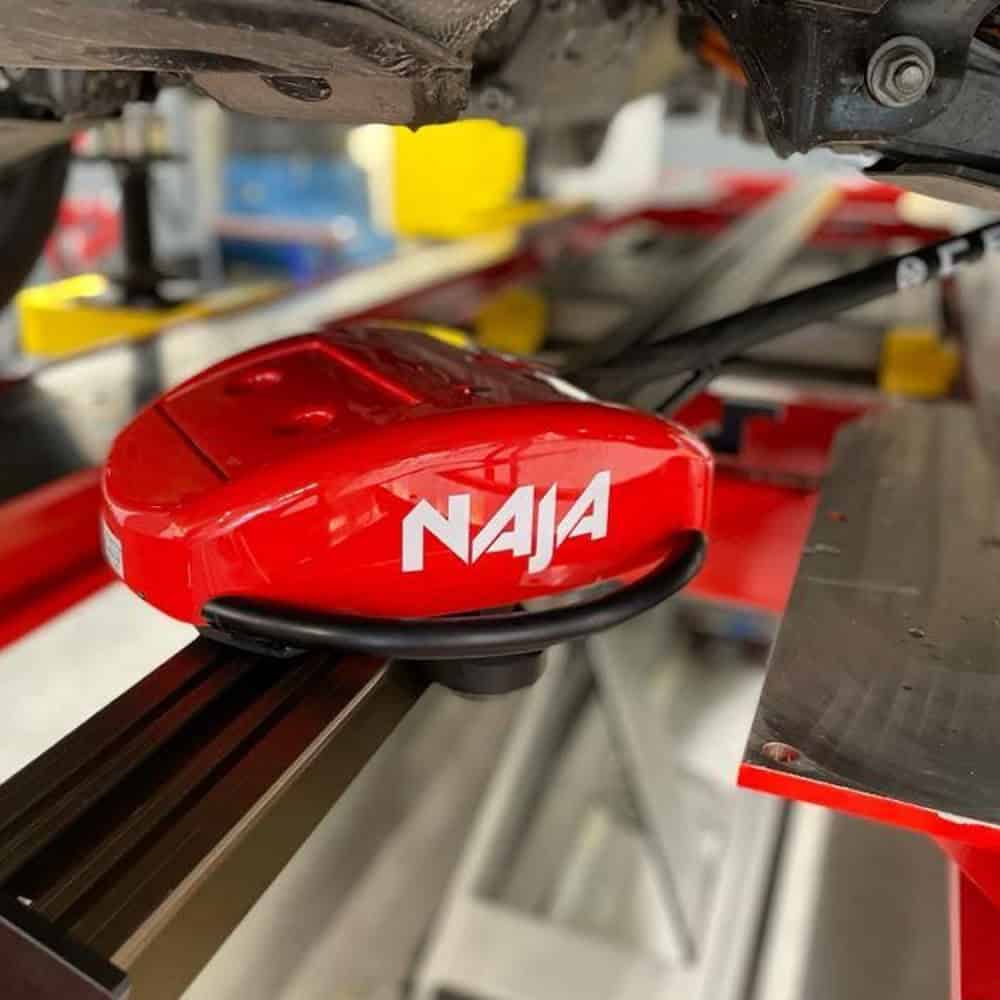
However, proven solutions exist: established mechanical repair systems—whether dedicated fixtures for specific vehicle models or universal systems—have documented decades of successful implementation potentially eliminating measurement dependencies while achieving the precision required for ADAS-equipped vehicles in enhanced time frames.
Professional considerations: The John Eagle case demonstrates that adherence to proper repair procedures represents essential professional practice. Precision-focused repairs designed to consistently meet OEM specifications may provide enhanced professional confidence and customer satisfaction.
The opportunity for the industry: embrace proven mechanical precision with established track records and potential superior efficiency, while continuing to evaluate measurement-dependent systems for optimal performance in specific applications.
Professional collision repair facilities investing in proven mechanical precision systems position themselves as industry leaders committed to documented excellence standards while potentially achieving superior operational efficiency. These facilities may better serve customers and communities while establishing themselves as preferred choices for vehicle owners and insurance partners who value comprehensive repair procedures.
The industry direction: proven mechanical precision represents a foundation for professional excellence, supported by decades of successful implementation and continued innovation.
What has been your experience with different repair methodologies? How do you evaluate operational efficiency and precision in collision repair? We welcome your professional insights and experiences.
#CollisionRepair #AutomotiveSafety #ADAS #MechanicalPrecision #VehicleSafety #ProfessionalRepair #AutomotiveExcellence #LinkedInAutomotive
About the Author: This analysis is based on extensive industry experience and professional observations. We encourage readers to evaluate repair methods based on their specific requirements and manufacturer specifications. This content is provided for informational purposes and represents professional opinion based on industry experience.
- https://rts.i-car.com/crn-1276.html
- https://www.sentricadas.com/press/ensuring-road-safety-oem-standard-adas-calibration-is-imperative
- https://www.youtube.com/watch?v=HQuCkoQscRs
- https://www.nationalcollisionrepairer.com.au/car-o-liner-and-i-car-discuss-body-measurements-and-tolerances/
- https://www.youtube.com/watch?v=x07kN-dGMHs
- https://www.autobodynews.com/news/the-dangerous-path-of-capping-adas-calibration-costs-a-warning-to-insurers-and-collision-repairers
- https://mattsharplaw.com/news/when-your-insurance-company-cuts-corners-on-your-car-accident-repair/
- https://mercedesblog.com/why-oem-certification-matters-for-quality-repairs/
- https://carcareplan.com/business/the-importance-of-oem-parts-and-vehicle-warranty
- https://reparlab.com/en/why-do-adas-systems-fail/
- https://fusionwindshield.com/2025/01/29/6-signs-your-adas-is-not-working-correctly/




